

Get Quote
Contact us now to receive a detailed quotation.
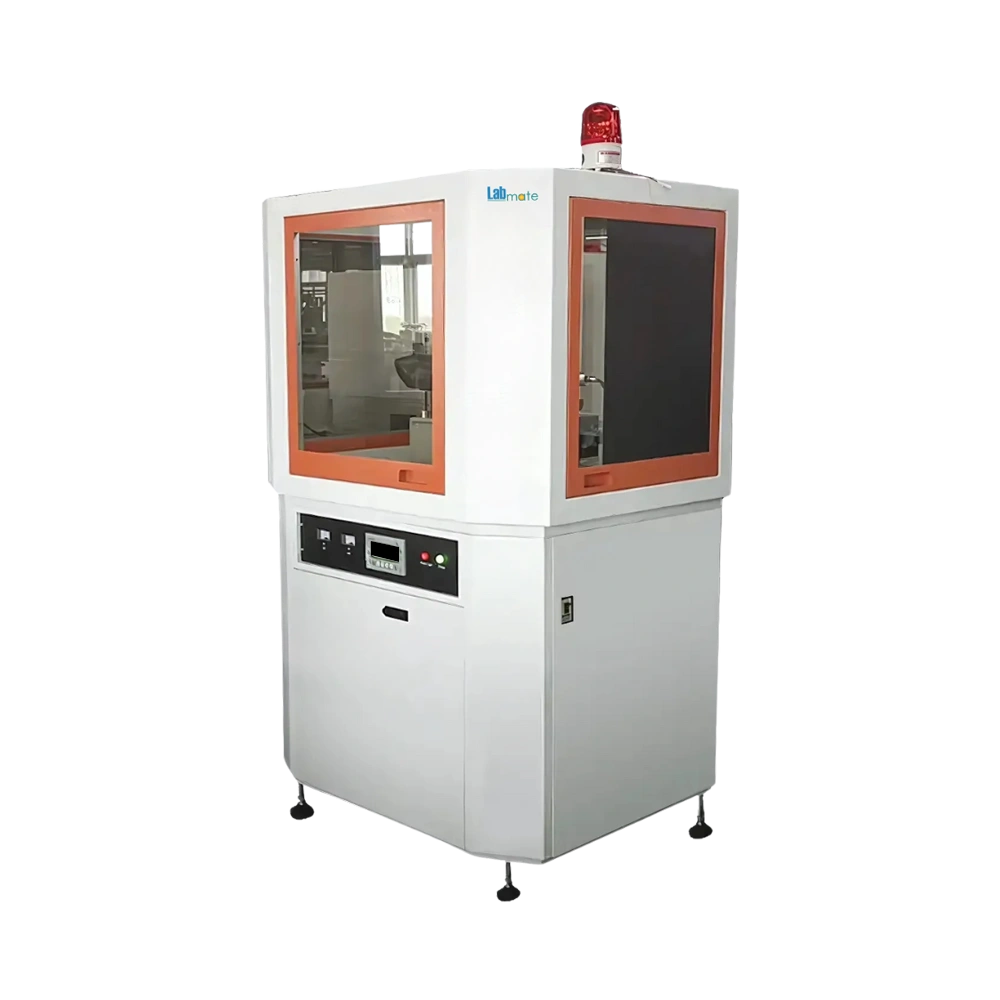
XRD Diffractometer LMXRD-A100 is equipped with glass, ceramic, and ripple ceramic tubes, each with target materials including Cu, Fe, Co, Cr, Mo, etc. It scans from 0 to 164˚ at speeds ranging from 0.0012 to 70˚ per minute. Our diffractometer features a horizontally configured goniometer capable of accommodating samples with diameters ranging from Ø to 2 Ø. It features programmable operations enabling navigation of variable parameters.
Specifications
| X-Ray Tube | Glass tube, ceramic tube, ripple ceramic tube: Cu, Fe, Co, Cr, Mo, etc., |
| Scanning Range | 0 to 164˚ |
| Scanning Speed | 0.0012 º to 70 º min |
| Focus Size | 1×10 mm/ 0.4 × 14 mm/ 2×12 mm |
| Stability | ≤0.01% |
| Tube Current | 5 to 80 mA |
| Tube Voltage | 10 to 60 kV |
| Rated Power | 3 kW |
| Goniometer Structure | Horizontal (Ø to 2 Ø) |
| Radius Of Diffraction | 185 mm |
| Maximum Resolving Speed | 100 º/ min |
| Scanning Mode | Ø to 2 Ø linkage,Ø, 2 Ø single action; continuous/stepping scanning |
| Angle Repeatable Accuracy | 1 / 1000 º |
| Minimal Stepping Angle | 1 / 1000 º |
| Maximum Counting Rate of Linearity | 5 × 10⁵ CPS |
| Energy Resolution Ratio | ≤ 25 % (PC), ≤ 50 % (SC) |
| Stability Of System Measure | ≤ 0.01 % |
| Scattered Rays Dose | ≤ 1 µ Sv/h (without X-ray protective device) |
| Instrument Integrative Stability | ≤ 0.5 % |
| Power Consumption | 2 kW |
| Dimension (W×D×H) | 1100 × 850 × 1750 mm |
| Weight | 25 Kg |
Pricing
| Product | Price | Unit | Action |
|---|---|---|---|
| XRD Diffractometer LMXRD-A100 | $ 57550 | Each of 1 |
Features
Offers crystallographic thermal analysis
Dual scanning methods
Phase identification of unknown samples
Phase analysis of known mixed blends
Metal material texture and stress analysis
Applications
It has wide applications across various scientific disciplines, contributing to advancements in materials science, developing new materials, or improving production efficiency.
Similar Products

$ 67712.5 / Each of 1
Frequently Asked Questions
1 What is an XRD Diffractometer?
An XRD Diffractometer is an apparatus designed to investigate the structure of crystalline materials.
2 How does an XRD Diffractometer work?
It utilizes X-ray diffraction to measure the angles and intensities of diffracted X-rays, enabling the determination of crystallographic structure of sample.
3 What types of samples can be analyzed using XRD diffractometer?
It can analyze a variety of samples such as metals, alloys, polymers, ceramics, minerals and pharmaceuticals.
4 Can XRD Diffractometer be used for quantitative analysis?
It is commonly used for quantitative phase analysis.
5 Can XRD Diffractometer be used for identifying unknown materials?
It is used to identify unknown crystalline materials by comparing their diffraction patterns to a database of known materials.
6 What is the difference between XRD Diffractometer and Electron Microscopy?
XRD Diffractometer provides information about the crystallographic structure of materials whereas Electron Microscopy provides detailed images of the surface morphology of sample.
7 Is XRD Diffractometer analysis affected by temperature?
Temperature influences the crystal structure and causes change in peak positions due to thermal expansion or contraction.
8 Can XRD Diffractometer be used for structural analysis of nanomaterials?
It is commonly used for analyzing nanomaterials, where peak broadening is used to estimate the nanocrystal size and identify structural defects.
9 Can XRD Diffractometer be used to study phase transitions in materials?
It is used to study phase transitions by observing changes in the diffraction pattern.
10 What is meant by Peak Deconvolution in XRD Diffractometer analysis?
It refers to the process of separating overlapping diffraction peaks to obtain accurate information about the phases and crystallographic properties of material.