

Get Quote
Contact us now to receive a detailed quotation.
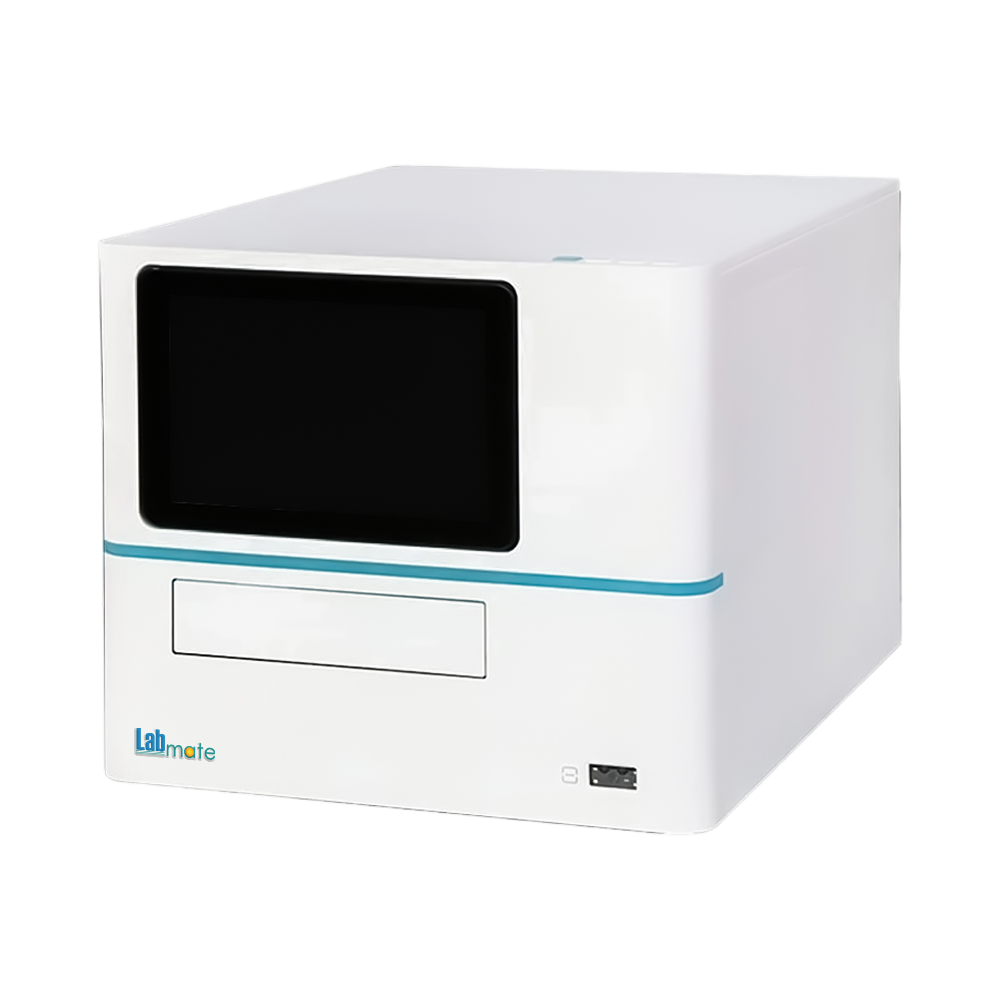
Microplate Reader LMRW-A102 offers multiple detection modes including absorbance, fluorescence and luminescence allowing for a wide range of assays. It can process both 96 and 384-well plate formats making it ideal for high-throughput screening. It maintains incubating temperature from RT +4 °C to 45 °C and ensures even heat distribution. Our microplate reader is equipped with a 10-inch LCD display for real-time monitoring of variable parameters.
Specifications
| Plate Formats | 96 and 384 wells |
| Detection Modes | Absorbance, fluorescence, luminescence |
| Absorbance Light Source | High-energy xenon flash lamp |
| Absorbance Detector | PD |
| Absorbance Wavelength Range | 200 to 1000nm, 1nm step |
| Absorbance Wavelength Accuracy | 2nm |
| Absorbance Wavelength Repeatability(SD) | 0.2nm |
| Absorbance Measuring Range | 0 to 4 OD |
| Absorbance Half Width | |
| Absorbance Accuracy | 96-precision mode0.0 to 2.0Abs ±(1.0 % + 0.003Abs)2.0 to 3.0Abs ±2.0 % |
| Absorbance Resolution | 0.0001 OD |
| Absorbance Repeatability | CV < 1.0 % or SD< 0.003 Fast (0.0 to 3.0Abs)CV < 0.5 % or SD< 0.003 Accurate (0.0 to 3.0Abs) |
| Stray Light | 0.1 % at 220nm |
| Linear | R2 > 0.999 at (0.0 to 3.0Abs) |
| Reading Time | 96-well plate in |
| Fluorescence Reading Mode | Top reading |
| Fluorescence Excitation Light Source | High-energy xenon lamp |
| Fluorescence Detector | PMT |
| Fluorescence Wavelength Range | EX: 200 to 1000nmEM: 270 to 850nm |
| Filter EX / EM | 3 groups |
| Fluorescence Detection Limit | ≤ 1 pm |
| Fluorescence Linear Dynamic Range | 6 logs |
| Luminescence Detector | PMT |
| Luminescence Detection Limit | 15amol / hole |
| Luminescence Linear Dynamic Range | 6 logs |
| Crosstalk | ≤0.005 % |
| Shaking Mode | Linear, circular, double circular |
| Shaking Speed | 1440 rpm (Vibration plate mode) |
| Incubation Temperature | RT. +4 °C to 45 °C |
| Temperature Uniformity | ±0.5 °C at 37 °C |
| Screen Size | 10-inch LCD display |
| Operation Method | Touch capacitive screen or mouse |
| Data Capacity | 10GB |
| Compatibility | Support PC software, Win7 to Win10 64 bit |
| Data Transmission and printer | via FTPConnect the printer via cable |
| Power Consumption | 160W, 24V, 6.67A |
| Dimension (W × D × H) | 420 × 550 × 386 mm |
| Net Weight | 33 Kg |
| Gross Weight | 40 Kg |
Pricing
| Product | Price | Unit | Action |
|---|---|---|---|
| Microplate Reader LMRW-A102 | $ 32575 | Pack of 1 |
Features
Numerous shaking modes
Data transmission via FTP
Equipped with high-energy xenon flash lamp
Supports large data storage
Standard Accessories
Microplate Reader ×1pcs Power cord ×1pcs Mouse ×1pcs U-Disk ×1pcs Dustproof plug ×1pcs Filter assembly ×1pcs
Optional Accessories
Reader and Data Analysis Software Microplate for low-volume samples Automatic Injector Module
Applications
Microplate Reader is widely used in ELISA, cell-based assays, nucleic acid quantification, protein quantification, fluorescence and luminescence assays, and drug discovery and development.
Selection Guide
Microplate Reader LMRW-A102 is a reliable instrument designed for high-throughput screening and quantification of biochemical reactions. It is particularly suitable for a wide range of research studies and clinical diagnostics due to its broad wavelength range and compatibility with various microplate formats. Researchers conducting ELISA, protein and nucleic acid quantification, enzyme kinetics, and cell-based assays will find this model beneficial. Its applications extend across pharmaceutical studies, immunological testing, and food safety analysis. The reader typically supports 96-well and 384-well microplates, providing flexibility for different assay formats. Certifications such as CE and ISO compliance ensure the device meets international quality and safety standards, enhancing its credibility for use in regulated laboratories. Customers looking for a microplate reader with accurate optical detection, multiple wavelength options, and robust performance in repeated testing scenarios will find this model an ideal choice.
Similar Products

$ 3825 / Each of 1

$ 36900 / Each of 1

$ 3512.5 / Pack of 1

$ 5662.5 / Each of 1

$ 16075 / Each of 1

$ 4147.5 / Each of 1

$ 7500 / Each of 1

$ 27100 / Each of 1

$ 3400 / Each of 1

$ 13625 / Each of 1

$ 49150 / Each of 1

$ 4612.5 / Each of 1

$ 3762.5 / Pack of 1
$ 32150 / Each of 1
Frequently Asked Questions
1 What is a Microplate Reader?
A Microplate Reader is an apparatus designed to detect biological, chemical, or physical events within the wells of a microplate.
2 How does Microplate Reader work?
It works by using optical detection methods such as absorbance, fluorescence, or luminescence to measure reactions in each well of a microplate.
3 Why is Microplate Reader important in drug discovery?
It is important in drug discovery because it enables high-throughput screening, allowing researchers to analyze thousands of samples quickly and accurately.
4 Can Microplate Reader be used for kinetic assays?
It is used for kinetic assays, allowing researchers to monitor changes in absorbance or fluorescence over time.
5 How is Microplate Reader used in ELISA assays?
It is used in ELISA assays to measure absorbance in microplate wells, quantifying the presence of specific proteins or antigens based on colorimetric changes.
6 Can Microplate Reader be used for cytotoxicity assays?
It can be used for cytotoxicity assays by detecting changes in absorbance or fluorescence that reflect cell viability or membrane integrity.
7 Can Microplate Reader be used for bacterial growth studies?
It can be used for bacterial growth studies by continuously measuring optical density, allowing researchers to monitor growth curves over time.
8 Can Microplate Reader be used for hormone detection?
It is commonly used for hormone detection in ELISA- or luminescence-based immunoassays, enabling accurate quantification of hormone levels in biological samples.
9 Can Microplate Reader be used in food safety testing?
It is used in food safety testing to detect contaminants, toxins, or pathogens via immunoassays or enzymatic reactions in microplate formats.
10 How is Microplate Reader used in environmental monitoring?
It is used in environmental monitoring for detecting pollutants, heavy metals, or microbial content using biochemical assays in water and soil samples.