

Get Quote
Contact us now to receive a detailed quotation.
Specifications
| Wavelength Range | 400nm to 630nm |
| Microplate Type | 96 well plate |
| Measure system | 8-channel optical system |
| Reading Range | 0.000 ~ 4.000 Abs |
| Bandwidth & Accuracy | 8nm ± 2nm |
| Repeatability | ≤1% |
| Temperature | 10°C to 35°C |
| Humidity | 15% to 85% |
| Stability | ±0.003 A |
| Standard Filters | 405,450,492,630nm & 4 optional |
| Light Source | Monochromatic LED |
| Reading Speed | 5s single wavelength for whole plate |
| Shaking | 3 shaking modes with variable time |
| Printer | Built-in thermal printer, optional external printer |
| Interface Connections | 4×USB, 1×RS232, SD card |
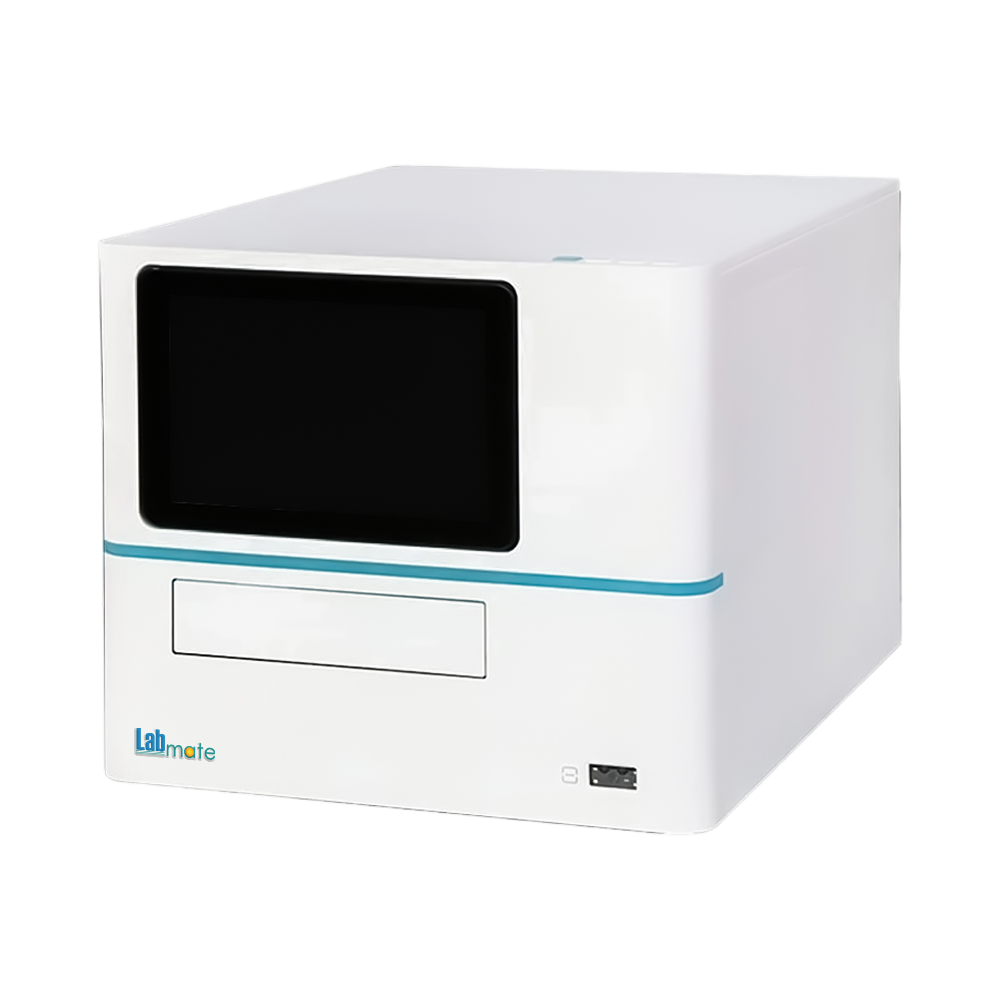
| Display | 7” TFT LCD, 800×480 pixels |
| Dimension (W×D×H) | 400×310×169 mm |
| Weight | 6 kg |
Pricing
| Product | Price | Unit | Action |
|---|---|---|---|
| Microplate Reader LMMR-M103 | $ 3512.5 | Pack of 1 |
Features
7” high resolution TFT LCD touch screen
3 linear shaking modes with variable time
LED light source with life span over 100,000 hours
Self-check, malfunction alarm
Large storage capacity up to 200 test protocols and 100,000 results
Bi-chromatic 8 channel optical fiber scanning
Single or dual wavelengths measurement
Performing 12 different tests in one plate
Extensive report with patient information
Auto lamp adjustment and auto calibration
User friendly and easy to program
Graphical operating interface
High quality long-life tungsten halogen lamp
Applications
Microplate Reader is suitable for many enzymatic and colorimetric assays such as immunoassays, reporter gene assays, protein quantification, DNA quantification, pesticide residue in food etc.
Selection Guide
Microplate Reader LMMR-M103 is an advanced laboratory instrument designed to meet the needs of various research studies and diagnostic applications. It is best suited for ELISA, protein quantification, enzyme activity analysis, and cell-based assays, where accurate optical density measurement is essential. With support for both 96- and 384-well plate formats, it ensures high-throughput screening, making it suitable for pharmaceutical, biotechnology, and clinical laboratories. The reader typically covers a wide wavelength range, allowing flexibility across multiple assay types. Certifications such as ISO and CE ensure reliability, compliance with international standards, and user safety. When selecting this model, customers should consider the types of assays they perform, throughput needs, wavelength requirements, and compatibility with lab protocols. Its user-friendly interface, robust performance, and regulatory compliance make it a dependable choice for consistent and accurate results.
Similar Products
$ 32150 / Each of 1

$ 3400 / Each of 1

$ 7500 / Each of 1

$ 3762.5 / Pack of 1

$ 3825 / Each of 1

$ 16075 / Each of 1

$ 4612.5 / Each of 1

$ 13625 / Each of 1

$ 49150 / Each of 1

$ 5662.5 / Each of 1

$ 32575 / Pack of 1

$ 4147.5 / Each of 1

$ 27100 / Each of 1

$ 36900 / Each of 1
Frequently Asked Questions
1 What is a Microplate Reader?
A Microplate Reader is an apparatus designed to detect biological, chemical, or physical events within the wells of a microplate.
2 How does Microplate Reader work?
It works by using optical detection methods such as absorbance, fluorescence, or luminescence to measure reactions in each well of a microplate.
3 Why is Microplate Reader important in drug discovery?
It is important in drug discovery because it enables high-throughput screening, allowing researchers to analyze thousands of samples quickly and accurately.
4 Can Microplate Reader be used for kinetic assays?
It is used for kinetic assays, allowing researchers to monitor changes in absorbance or fluorescence over time.
5 How is Microplate Reader used in ELISA assays?
It is used in ELISA assays to measure absorbance in microplate wells, quantifying the presence of specific proteins or antigens based on colorimetric changes.
6 Can Microplate Reader be used for cytotoxicity assays?
It can be used for cytotoxicity assays by detecting changes in absorbance or fluorescence that reflect cell viability or membrane integrity.
7 Can Microplate Reader be used for bacterial growth studies?
It can be used for bacterial growth studies by continuously measuring optical density, allowing researchers to monitor growth curves over time.
8 Can Microplate Reader be used for hormone detection?
It is commonly used for hormone detection in ELISA- or luminescence-based immunoassays, enabling accurate quantification of hormone levels in biological samples.
9 Can Microplate Reader be used in food safety testing?
It is used in food safety testing to detect contaminants, toxins, or pathogens via immunoassays or enzymatic reactions in microplate formats.
10 How is Microplate Reader used in environmental monitoring?
It is used in environmental monitoring for detecting pollutants, heavy metals, or microbial content using biochemical assays in water and soil samples.