

Get Quote
Contact us now to receive a detailed quotation.
Specifications
| Plate type | 96 well plate |
| Standard Wavelength | 405, 450, 492, 630 nm |
| Wavelength accuracy | ± 1 nm |
| Resolution | 0.001 Abs |
| Reading speed (Single wavelength) | 5 secs for 96 well plate |
| Photometric Range | 0.000 – 4.000 Abs |
| Accuracy | ± 0.5 % or ± 0.005 A |
| Optic system | 8-channel optic fibre system |
| Band width | < 8 nm |
| Read Methods | End Point, Two Point and Kinetic |
| Calculation mode | ABS, Cut-off, Single standard, Curve, Multi-percent, Percent Logarithm, Linear Regression, Exponent Regression, Power Regression, 4LP Regression |
| Operation | PC operation, bidirectional communications |
| Memory | >100 programs & upto 100,000 test results |
| Interface | RS – 232 and USB |
| Light source | Halogen lamp (8 V / 20 W) |
| Dimensions | 454 x 295 x 146 mm |
| Weight | 7 Kg |
Pricing
| Product | Price | Unit | Action |
|---|---|---|---|
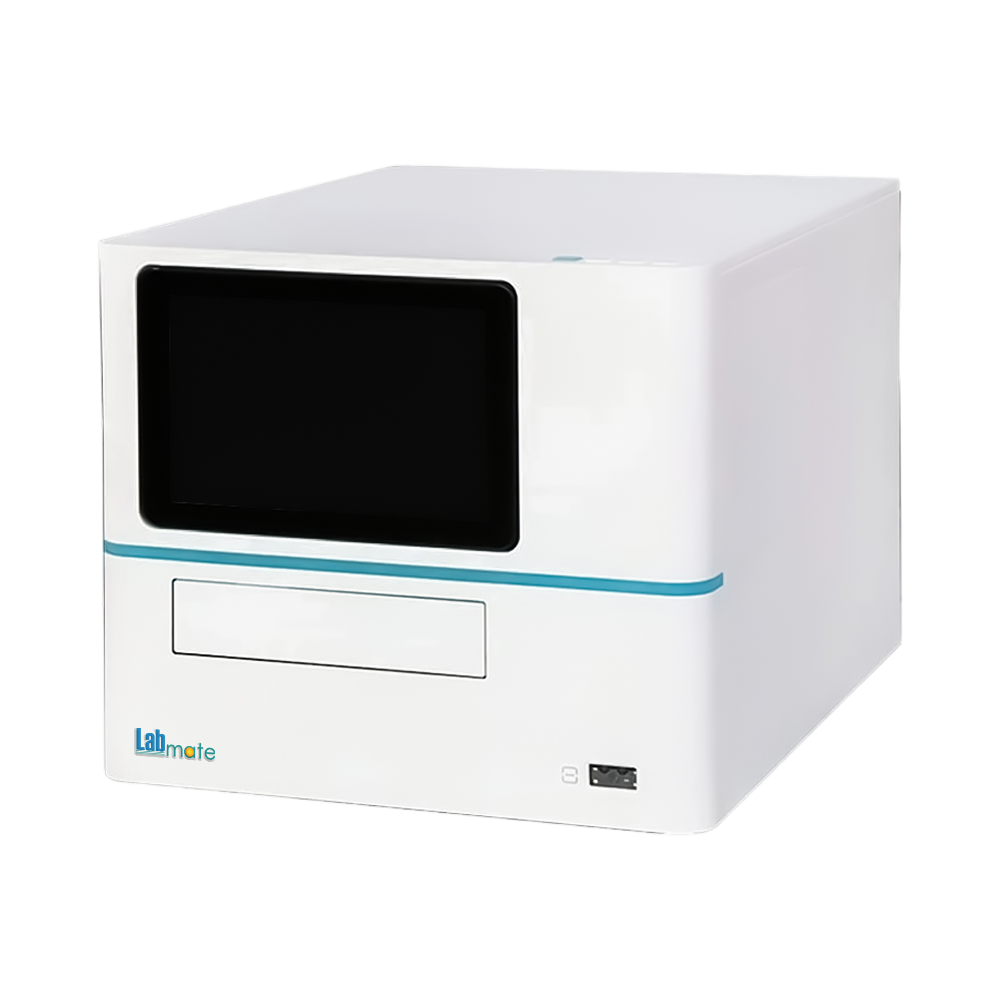
| Microplate Reader LMRW-A100 | $ 49150 | Each of 1 |
Features
8-channel optical fibre system i.e. 5 sec reading for the whole plate Biochromatic measurement and calculations available Storage of 100 test protocol and 100,000 sample results Multi-assay feature – up to 12 different assay on a plate Automatic data saving Adjustable shaking time and speed Powerful QC functions and programs
Optional Accessories
Microfluidic Detection Board
Automatic Sampler
Selection Guide
Microplate Reader LMRW-A100 is a versatile and reliable instrument designed to meet the demands of various research and clinical applications. It is suitable for use in ELISA, enzyme activity assays, protein quantification, cell viability testing, and other absorbance-based assays commonly conducted in research laboratories, diagnostic centers, and pharmaceutical environments. Its compatibility with 96-well microplates makes it suitable for high-throughput screening, while the wavelength range and photometric accuracy ensure consistent and accurate results. The reader complies with key international certifications (such as CE and ISO standards), pro assurance of safety, quality, and performance. When selecting this model, customers should consider its application in studies that require UV-visible absorbance detection, broad wavelength selection, and automated data handling, making it a dependable choice for routine and advanced experimental workflows.
Similar Products

$ 4612.5 / Each of 1

$ 7500 / Each of 1

$ 3400 / Each of 1

$ 16075 / Each of 1
$ 32150 / Each of 1

$ 36900 / Each of 1

$ 3512.5 / Pack of 1

$ 5662.5 / Each of 1

$ 27100 / Each of 1

$ 4147.5 / Each of 1

$ 3825 / Each of 1

$ 32575 / Pack of 1

$ 13625 / Each of 1

$ 3762.5 / Pack of 1
Frequently Asked Questions
1 What is a Microplate Reader?
A Microplate Reader is an apparatus designed to detect biological, chemical, or physical events within the wells of a microplate.
2 How does Microplate Reader work?
It works by using optical detection methods such as absorbance, fluorescence, or luminescence to measure reactions in each well of a microplate.
3 Why is Microplate Reader important in drug discovery?
It is important in drug discovery because it enables high-throughput screening, allowing researchers to analyze thousands of samples quickly and accurately.
4 Can Microplate Reader be used for kinetic assays?
It is used for kinetic assays, allowing researchers to monitor changes in absorbance or fluorescence over time.
5 How is Microplate Reader used in ELISA assays?
It is used in ELISA assays to measure absorbance in microplate wells, quantifying the presence of specific proteins or antigens based on colorimetric changes.
6 Can Microplate Reader be used for cytotoxicity assays?
It can be used for cytotoxicity assays by detecting changes in absorbance or fluorescence that reflect cell viability or membrane integrity.
7 Can Microplate Reader be used for bacterial growth studies?
It can be used for bacterial growth studies by continuously measuring optical density, allowing researchers to monitor growth curves over time.
8 Can Microplate Reader be used for hormone detection?
It is commonly used for hormone detection in ELISA- or luminescence-based immunoassays, enabling accurate quantification of hormone levels in biological samples.
9 Can Microplate Reader be used in food safety testing?
It is used in food safety testing to detect contaminants, toxins, or pathogens via immunoassays or enzymatic reactions in microplate formats.
10 How is Microplate Reader used in environmental monitoring?
It is used in environmental monitoring for detecting pollutants, heavy metals, or microbial content using biochemical assays in water and soil samples.