

Get Quote
Contact us now to receive a detailed quotation.

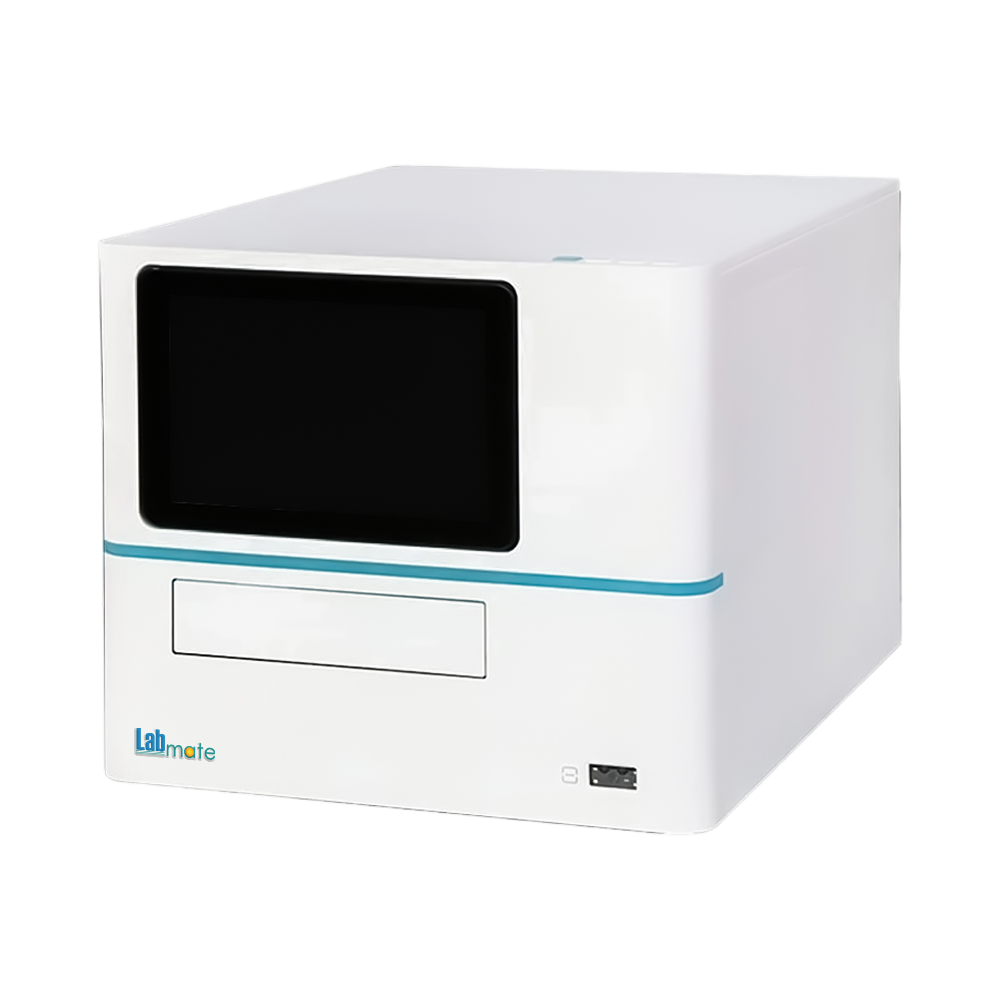
Microplate Reader LMMR-A201 offers fluorescence and chemiluminescence detection modes with 1 nm resolution. Equipped with high-sensitivity photomultiplier tube detectors, it ensures reliable measurement across wide dynamic range. Integrates temperature-controlled incubation and plate shaking functions, providing optimal conditions for various assays. Its excitation and emission filter wheel design enables flexible wavelength selection. Our Microplate Reader with advanced data analysis software streamlines experimental workflows.
Specifications
| Detection Modes | Fluorescence, Chemiluminescence |
| Microplate Compatibility | 6/12/24/48/96/384 Microplate |
| Excitation Wavelength Range | 320 to 1000 nm |
| Emission Wavelength Range | 360 to 800 nm |
| Wavelength Resolution | 1nm |
| Wavelength Bandwidth | 30nm |
| Wavelength Accuracy | Less than 0.2nm |
| Fluorescence Sensitivity | less than 2 fmol fluorescein/well |
| Dynamic Range | Greater than 6 orders of magnitude |
| Fluorescence Detector | Photomultiplier Tube |
| Reading Mode | Top Reading |
| Chemiluminescence Wavelength Range | 270 to 670 nm |
| Chemiluminescence Sensitivity | Less than 40 amol ATP/well |
| Chemiluminescence Detector | Photomultiplier Tube |
| Light Sources | Tungsten Lamp |
| Temperature Control | RT +2 °C to 45 °C |
| Oscillation Mode | Linear |
| Oscillation Amplitude Levels | Low/Medium/High |
| Connectivity | USB interface |
| Dimension | 580×470×450 mm |
| Weight | 33Kg |
Pricing
| Product | Price | Unit | Action |
|---|---|---|---|
| Microplate Reader LMMR-A201 | $ 27100 | Each of 1 |
Features
Linear oscillation
Adjustable amplitude levels
USB connectivity
User-friendly interface
Uniform sample mixing
Accommodates multiple plate formats
Applications
Microplate Reader LMMR-A201 is employed in protein and enzyme activity assays, DNA/RNA quantification, reporter gene studies, microbial growth analysis, ATP measurement, reactive oxygen species detection, and chemiluminescence kinetics.
Similar Products

$ 5662.5 / Each of 1

$ 3825 / Each of 1

$ 49150 / Each of 1

$ 3512.5 / Pack of 1

$ 32575 / Pack of 1

$ 4147.5 / Each of 1

$ 16075 / Each of 1

$ 7500 / Each of 1

$ 3762.5 / Pack of 1

$ 36900 / Each of 1

$ 4612.5 / Each of 1
$ 32150 / Each of 1

$ 3400 / Each of 1

$ 13625 / Each of 1
Frequently Asked Questions
1 What is a Microplate Reader?
A Microplate Reader is an apparatus designed to detect biological, chemical, or physical events within the wells of a microplate.
2 How does Microplate Reader work?
It works by using optical detection methods such as absorbance, fluorescence, or luminescence to measure reactions in each well of a microplate.
3 Why is Microplate Reader important in drug discovery?
It is important in drug discovery because it enables high-throughput screening, allowing researchers to analyze thousands of samples quickly and accurately.
4 Can Microplate Reader be used for kinetic assays?
It is used for kinetic assays, allowing researchers to monitor changes in absorbance or fluorescence over time.
5 How is Microplate Reader used in ELISA assays?
It is used in ELISA assays to measure absorbance in microplate wells, quantifying the presence of specific proteins or antigens based on colorimetric changes.
6 Can Microplate Reader be used for cytotoxicity assays?
It can be used for cytotoxicity assays by detecting changes in absorbance or fluorescence that reflect cell viability or membrane integrity.
7 Can Microplate Reader be used for bacterial growth studies?
It can be used for bacterial growth studies by continuously measuring optical density, allowing researchers to monitor growth curves over time.
8 Can Microplate Reader be used for hormone detection?
It is commonly used for hormone detection in ELISA- or luminescence-based immunoassays, enabling accurate quantification of hormone levels in biological samples.
9 Can Microplate Reader be used in food safety testing?
It is used in food safety testing to detect contaminants, toxins, or pathogens via immunoassays or enzymatic reactions in microplate formats.
10 How is Microplate Reader used in environmental monitoring?
It is used in environmental monitoring for detecting pollutants, heavy metals, or microbial content using biochemical assays in water and soil samples.