

Get Quote
Contact us now to receive a detailed quotation.
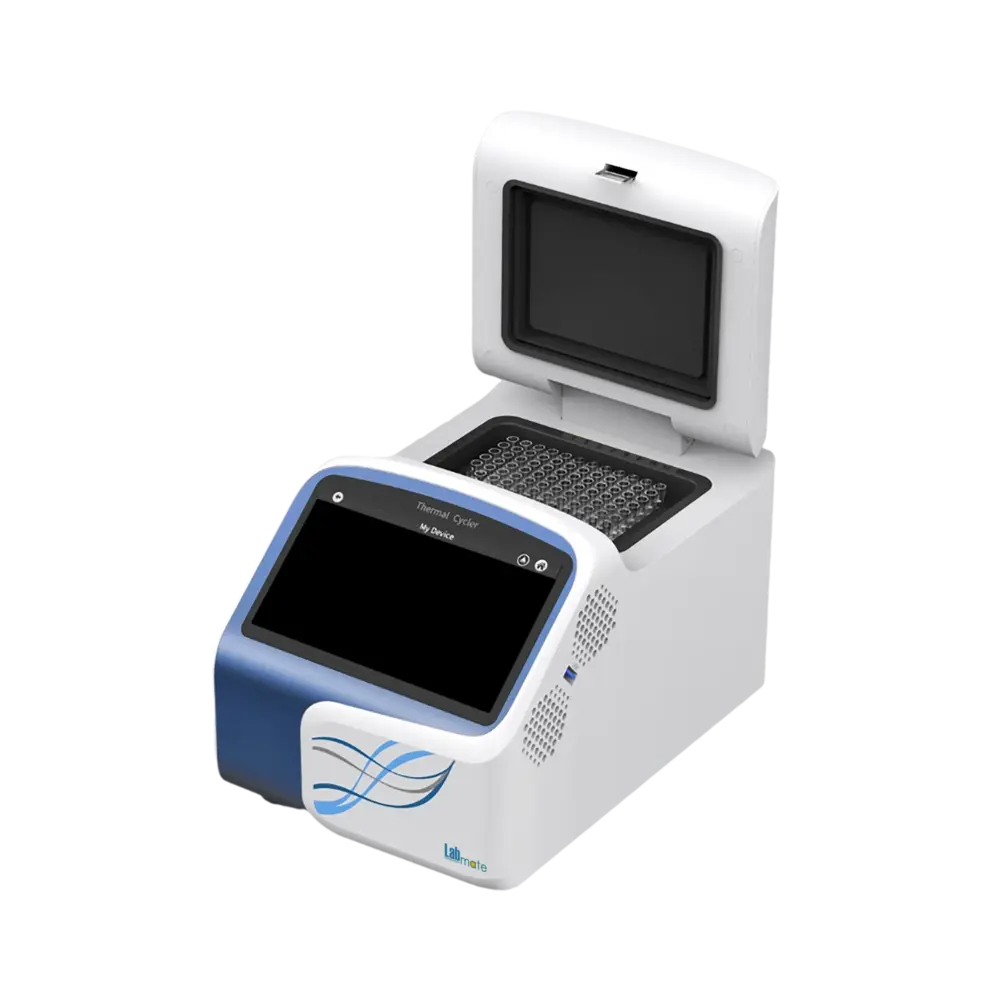
Gradient Thermal Cycler LMGT-C102 offers gradient temperature range of 1 to 36℃. It features compact, lightweight build that ensures easy placement in any laboratory setup. Equipped with dual modes, it shows actual sample or block temperature for flexible and faster reactions. Incorporates programming system with adjustable timing and ramp rates. Our Thermal Cycler enables gene amplification in research centers, genetic screening, and diagnostic laboratories.
Specifications
| Capacity | 96×0.2 ml |
| Gradient Temperature | 1 to 36°C |
| Ramp Rate | 4°C/s |
| Block Temperature Range | 4 to 99.9°C |
| Temperature Uniformity | ±0.3℃ |
| Temperature Control | Industrial-grade semiconductor system |
| Temperature Distribution | ± 0.3°C (55°C) |
| Temperature Accuracy | Less than or equal to ± 0.1℃ (55°C) |
| Temperature Control Mode | Block mode, Tube mode |
| Ram Rate Adjusting Range | 0.1 to 4.5°C |
| Maximum Cycles | 99 |
| Hot Lid Temperature Accuracy | ± 0.5℃ |
| Hot Lid Temperature Range | Room temperature + 5 to 110 ℃ |
| Program Capacity | Infinite |
| Display | Touch screen |
| Communication Interface | USB |
| Power Consumption | 600 W |
| Dimensions | 187×176×280 mm |
| Weight | 7 kg |
Pricing
| Product | Price | Unit | Action |
|---|---|---|---|
| Gradient Thermal Cycler LMGT-C102 | $ 3256.25 | Each of 1 |
Features
Fast ramping rate
Tm calculator
Graph-text interface
Touch screen panel
Side ventilation slots
Applications
Gradient Thermal Cycler LMGT-C102 is applied for gene amplification for molecular biology, food safety testing, genetic screening, and animal disease detection in research centers, and diagnostic labs.
Similar Products

$ 4375 / Pack of 1

$ 3862.5 / Pack of 1

$ 3862.5 / Pack of 1

$ 3762.5 / Pack of 1

$ 4637.5 / Each of 1

$ 3862.5 / Pack of 1

$ 3937.5 / Pack of 1

$ 3431.25 / Each of 1

$ 3762.5 / Pack of 1

$ 4743.75 / Each of 1

$ 3587.5 / Pack of 1

$ 3262.5 / Pack of 1

$ 3743.75 / Each of 1

$ 3525 / Pack of 1
Frequently Asked Questions
1 What is a Gradient Thermal Cycler?
A Gradient Thermal Cycler is a PCR machine designed for simultaneous testing of different annealing temperatures across a temperature gradient.
2 How does Gradient Thermal Cycler work?
It works by creating a temperature gradient across the block, enabling multiple PCR reactions to be run at slightly different temperatures in the same cycle.
3 Can Gradient Thermal Cycler be used for multiplex PCR?
It is ideal for multiplex PCR, as it helps determine a temperature that works efficiently for multiple primer sets in the same reaction.
4 How does Gradient Thermal Cycler improve PCR efficiency in research labs?
It improves PCR efficiency in research labs by reducing trial-and-error cycles and enabling faster optimization of reaction conditions.
5 Is Gradient Thermal Cycler useful in genotyping applications?
It is widely used in genotyping to optimize conditions for amplifying specific alleles or polymorphisms accurately.
6 How does Gradient Thermal Cycler support environmental DNA (eDNA) analysis?
It supports eDNA analysis by enabling rapid optimization of PCR conditions for complex, low-abundance DNA targets in environmental samples.
7 Is Gradient Thermal Cycler beneficial for forensic DNA analysis?
It is highly beneficial for forensic DNA analysis, where precise optimization is required to amplify minute or degraded DNA samples reliably.
8 How does Gradient Thermal Cycler support microbiome or metagenomics studies?
It supports microbiome and metagenomics studies by enabling precise amplification of complex microbial DNA mixtures with optimized conditions.
9 Can Gradient Thermal Cycler be used for pathogen detection in food safety testing?
It is commonly used in food safety testing to optimize PCR conditions for detecting bacterial, viral, or fungal pathogens in food samples.
10 How does Gradient Thermal Cycler support molecular diagnostics in clinical labs?
It supports molecular diagnostics by allowing rapid and accurate PCR optimization for disease-specific genetic markers.