

Get Quote
Contact us now to receive a detailed quotation.


Specifications
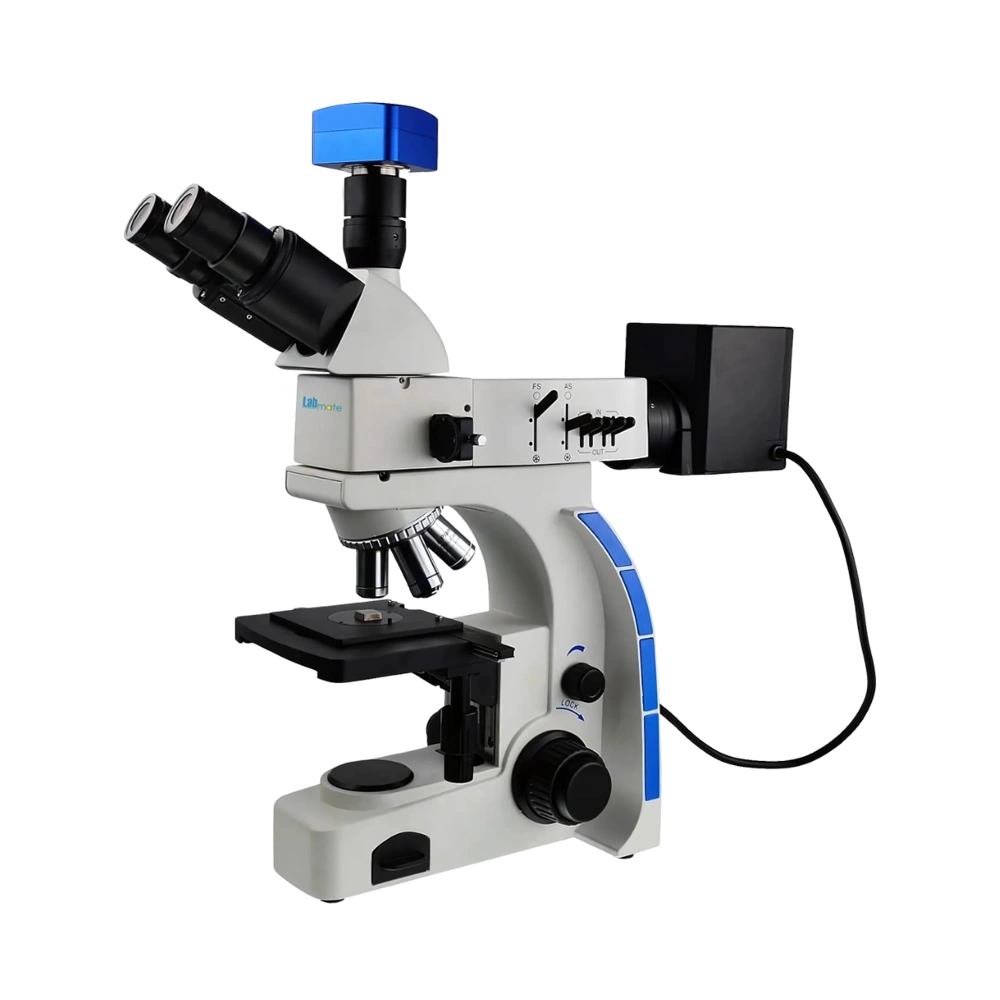
| Viewing Head | 30° Inclined angle |
| Objective | 5X/10X/20X/50X |
| Nosepiece | 5 Holes |
| Condenser | Abbe Condenser NA1.25 With Iris Diaphragm |
| Eyepiece | WF10X20 |
| Light Source | 6V 20W /12V 50W |
| Color | White/ Blue And Black |
Pricing
| Product | Price | Unit | Action |
|---|---|---|---|
| Metallurgical Microscope LMMM-702 | $ 2812.5 | Pack of 1 |
Features
Eyepieces can be secured to the tubes
All optics are anti-fungus and anti-reflection coated for maximum light throughput
Infinity professional LWD objectives 5x/0.13 10x/0.25 20x/0.40 S50x/0.70 S100x/1.25 are used as optional
Coarse adjustment are equipped with friction control
Uses different lighting method than a conventional microscope and can illuminate solid specimens to identify, inspect and measure them
Adjustable interpupillary distance
Equipped with diopter adjustments
Supplier with power cord, dust cover and spare fuse
Applications
These are commonly used in industry for quality control and inspection or for measuring instruments for viewing thin films and electroplating, inclusions, surface defects and grain size
Similar Products

$ 5025 / Each of 1

$ 3225 / Each of 1

$ 3850 / Each of 1

$ 2700 / Each of 1
$ 2575 / Pack of 1

$ 5350 / Each of 1

$ 2937.5 / Each of 1
Frequently Asked Questions
1 What is a Metallurgical Microscope?
A Metallurgical Microscope is an apparatus designed specifically for observing and analyzing the microstructure of metals and other solid materials.
2 How does Metallurgical Microscope work?
It works by using reflected light rather than transmitted light, allowing the observation of opaque specimens such as metals.
3 Can Metallurgical Microscope analyze grain size in metals?
It is commonly used to analyze grain size, phase boundaries, and microstructures in metallic samples.
4 What kind of samples can be observed under Metallurgical Microscope?
It can observe polished and etched metal samples, coatings, welds, failures, and surface treatments.
5 Can Metallurgical Microscope be used for quality control?
It is widely used in quality control processes to inspect metal parts for defects, uniformity, and adherence to industry standards.
6 Can Metallurgical Microscope be used for coating thickness measurement?
It is used to measure coating thickness by analyzing cross-sectional samples prepared through precise polishing and etching.
7 Can Metallurgical Microscope be used in studying corrosion?
It is used to study corrosion by examining surface pitting, intergranular attack, and oxide layer formation in metals.
8 How does Metallurgical Microscope assist in analyzing cast iron microstructures?
It assists in analyzing cast iron microstructures by revealing graphite morphology, matrix composition, and the distribution of carbides or pearlite.
9 How is Metallurgical Microscope used in the analysis of forged components?
It is used to inspect forged components for grain flow patterns, inclusions, and potential material segregation resulting from forging processes.
10 What is the role of Metallurgical Microscope in aerospace material testing?
It plays a key role in aerospace material testing by analyzing high-performance alloys for fatigue cracks, microstructural uniformity, and oxidation layers.