
Get Quote
Contact us now to receive a detailed quotation.
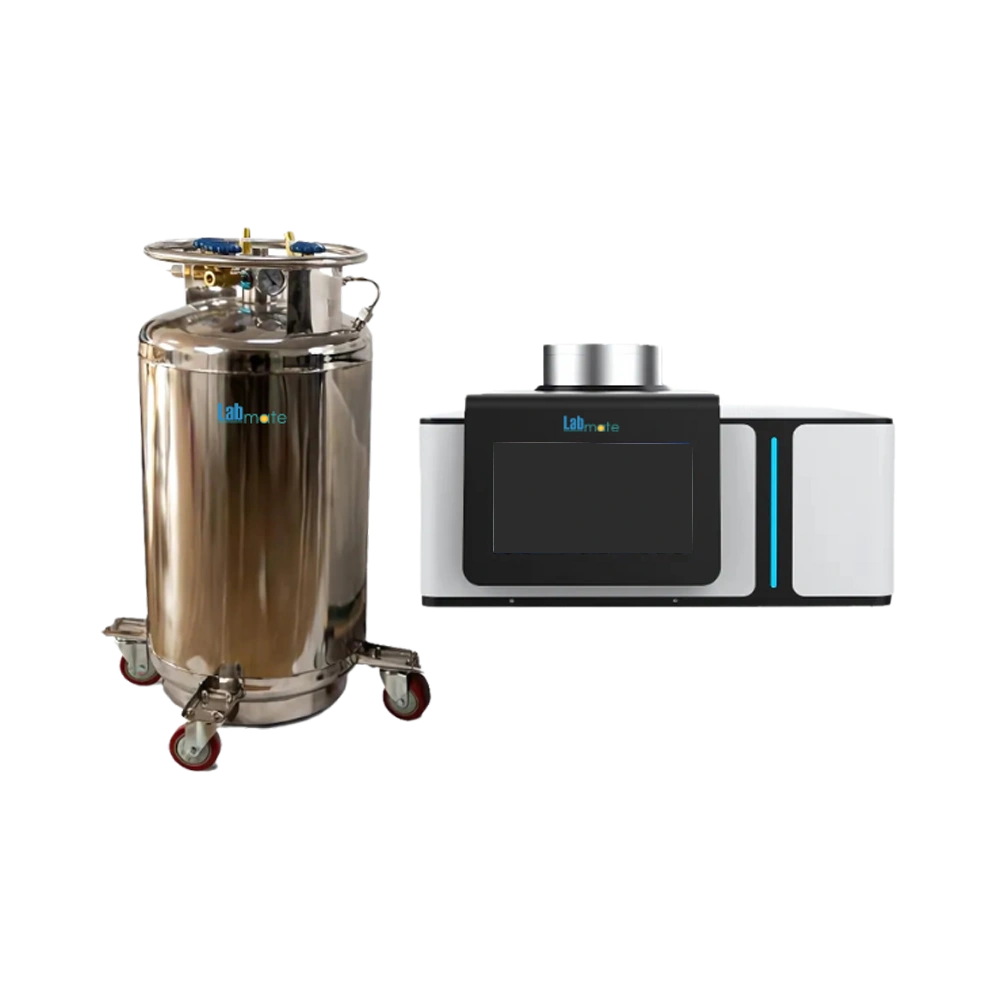
Differential Scanning Calorimeter LMDSC-B102 features -170 to 600 ℃ temperature range. Its liquid nitrogen cooling system combined with dual temperature control enables ultra-low operations. Its high-sensitivity dual sensors, supported by multi-point calibration, ensure reliable readings. Its baseline deduction function and auto data plotting, streamline result interpretation and thermal event visualization. Our Differential Scanning Calorimeter is ideal for analysing melting point, crystallization, and reaction kinetics.
Specifications
| DSC Range | 0 to ±2000 mW |
| Temperature Range | -170 to 600 ℃ |
| Sampling Rate | 1 to 10 Hz (Programmable) |
| Toggle Rate | 16.6 Hz |
| Heating Rate | 0.1 to 100 ℃/min |
| Temperature Resolution | 0.001 ℃ / 0.01 ℃ |
| Temperature Repeatability | ±0.01 ℃ |
| Program Temperature Control | 12-stage |
| Temperature Control Type | Heating, constant temperature, cooling |
| Scan Type | Heating, cooling, isothermal scanning |
| DSC Noise | 0.01 mW |
| DSC Resolution | 0.01 µW |
| DSC Accuracy | 0.001 mW |
| DSC Sensitivity | 0.001 mW |
| Gas flow rate | 0 to 200mL/min |
| Gas pressure | 0.2MPa |
| Dimension | 2350 × 1100 × 950 mm |
| Gross Weight | 40 Kg |
Pricing
| Product | Price | Unit | Action |
|---|---|---|---|
| Differential Scanning Calorimeter LMDSC-B102 | $ 15525 | Each of 1 |
Features
High-frequency processor
Optimized PID algorithm
7-inch LCD touchscreen
Independent atmosphere control
Automatic air path switching
USB bidirectional interface
Standard Accessories
Model No | Accessory | Unit | Quantity |
LMDSC-B102-H1 | DSC System Host | Set | 1 |
LMDSC-B102-H2 | Power Cord | Each | 1 |
LMDSC-B102-H3 | System Software USB | Each | 1 |
LMDSC-B102-H4 | Data Cable | Each | 1 |
LMDSC-B102-H5 | Aluminum Crucible | Each | 100 |
LMDSC-B102-H6 | Tweezers | Each | 1 |
LMDSC-B102-H7 | Fuses | Each | 5 |
LMDSC-B102-H8 | Trachea | Each | 2 |
LMDSC-B102-H9 | Sample Spoon | Each | 1 |
Applications
Differential Scanning Calorimeter LMDSC-B102 is ideal for studying reaction kinetics, phase transitions, thermal stability, and heat capacity in polymers, pharmaceuticals, composites, and other process-optimization environments.
Similar Products
$ 6400 / Each of 1

$ 13400 / Each of 1

$ 16800 / Each of 1

$ 10650 / Pack of 1

$ 24587.5 / Each of 1

$ 9582.5 / Each of 1

$ 16262.5 / Each of 1
$ 11150 / Each of 1
Frequently Asked Questions
1 What is a Differential Scanning Calorimeter?
A Differential Scanning Calorimeter is an apparatus designed to measure heat flow differences between a sample and a reference to analyze thermal transitions.
2 How does a Differential Scanning Calorimeter work?
It works by heating or cooling a sample and comparing its heat flow to that of a reference material to detect thermal events.
3 What materials can be analyzed using Differential Scanning Calorimeter?
It can analyze a wide range of materials, including polymers, metals, pharmaceuticals and liquids.
4 Can Differential Scanning Calorimeter analyze chemical reactions?
It can analyze chemical reactions by measuring the heat released or absorbed during the reaction.
5 Can Differential Scanning Calorimeter be used to study pharmaceutical formulations?
It is used to investigate the thermal behavior of pharmaceutical compounds, including melting points, stability and interactions between active ingredients and excipients.
6 Can Differential Scanning Calorimeter be used for biodegradable material research?
It is used to study the thermal properties of biodegradable materials, helping in the development of eco-friendly materials with specific thermal behaviors.
7 Can Differential Scanning Calorimeter be used in environmental studies?
It is used to analyze the thermal properties of materials in environmental applications, such as evaluating the thermal degradation of pollutants or studying biopolymer stability.
8 Can Differential Scanning Calorimeter be used to evaluate textile materials?
It is used to analyze the thermal behavior of textile materials, including their melting points and heat resistance.
9 Can Differential Scanning Calorimeter be used to study nanocomposites?
It is used to study the thermal properties of nanocomposites, such as their melting points, glass transitions, and curing behaviors.
10 What is the role of Differential Scanning Calorimeter in studying food packaging materials?
It is used to study the thermal behavior of food packaging materials, such as their melting and crystallization points, in order to ensure that they maintain food quality and prevent spoilage.