

Get Quote
Contact us now to receive a detailed quotation.
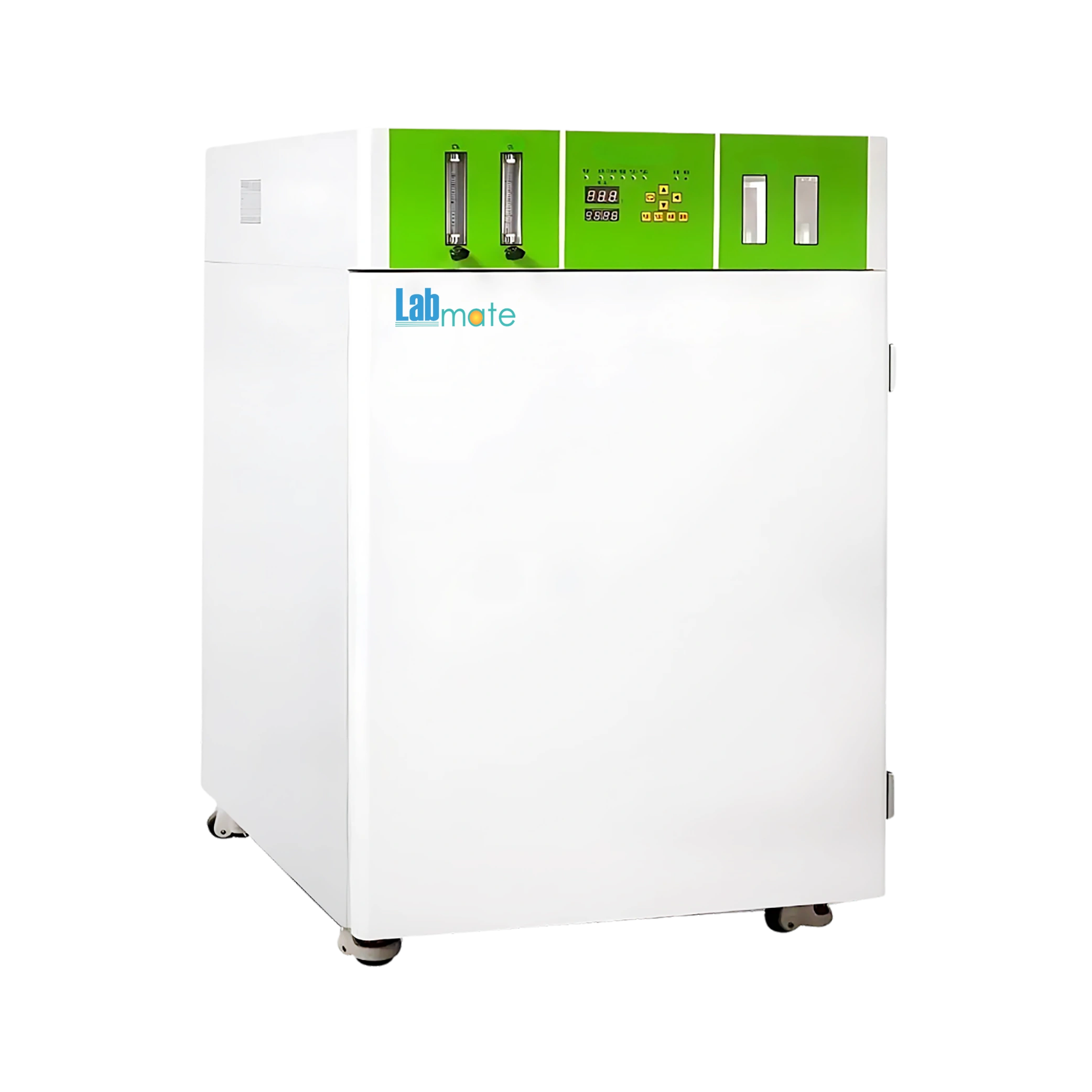
CO₂ Incubator LMCOI-A101 offers 160 L capacity to accommodate multiple vessels for dense sample growth. It features a transparent glass inner door that allows easy observation without affecting the internal environment. Integrated with temperature range from +5°C to 50°C for maintaining consistent incubation requirements. Equipped with a digital interface for real-time monitoring on operational parameters during continuous workflow. Our CO₂ Incubator includes a programmable timer between 0 to 999 minutes for scheduled culturing processes.
Specifications
| Chamber Volume | 160 L |
| Temperature Range | Room temperature +5°C to 50°C |
| Temperature Resolution | ± 0.5℃ |
| Heating Mode | Water-jacket |
| Inner Chamber Material | Stainless Steel with inner glass door |
| Timing Range | 0 to 999 minutes |
| Display | Digital |
| Control System | Microprocessor PID control |
| Alarm System | Over temperature alarm, CO₂ alarm (sound and light) |
| CO₂ Concentration Range | 0 to 20 % |
| CO₂ Concentration Precision | ± 0.1℃ |
| Filter | Double gas filter |
| Power Consumption | 950W |
| Power Supply | 110V, 60Hz / 220V, 50Hz |
| Working Dimensions (W×D×H) | 500×500×650 mm |
| Overall Dimensions (W×D×H) | 680×670×1000 mm |
| Packaging Dimensions (W×D×H) | 780×750×1090 mm |
| Net Weight | 66 kg |
| Gross Weight | 98 kg |
Pricing
| Product | Price | Unit | Action |
|---|---|---|---|
| CO₂ Incubator LMCOI-A101 | $ 6575 | Each of 1 |
Features
Stainless Steel Chamber
Water-Jacket Heating System
Microprocessor PID Control
Dual-Stage Gas Filtration
Built-In Alarm Alert
Applications
CO₂ Incubator LMCOI-A101 is employed in cytotoxicity analysis, drug development, and biosimilar research by ensuring consistent conditions for reliable experimental performance.
Similar Products

$ 3962.5 / Each of 1

$ 8350 / Set of 1

$ 5257.5 / Each of 1

$ 6712.5 / Set of 1

$ 6380 / Each of 1

$ 4150 / Each of 1

$ 7087.5 / Set of 1

$ 16125 / Each of 1

$ 8802.5 / Each of 1

$ 3458.75 / Each of 1

$ 7800 / Each of 1

$ 9256.25 / Each of 1

$ 4137.5 / Each of 1

$ 7375 / Each of 1
$ 3812.5 / Each of 1
Frequently Asked Questions
1 What is a CO2 Incubator?
A CO2 Incubator is an apparatus designed to create a controlled environment for cell and tissue culture by maintaining optimal temperature, humidity, and CO2 levels.
2 How does CO2 Incubator maintain CO2 levels?
It maintains CO2 levels through a sensor-based feedback system that regulates the injection of CO2 gas to ensure a stable and ideal culture environment.
3 How is CO2 Incubator used in stem cell research?
It is used in stem cell research to maintain the precise environmental conditions necessary for the proliferation and differentiation of stem cells.
4 How does CO2 Incubator benefit cancer cell culture studies?
It benefits cancer cell culture studies by enabling consistent growth conditions for tumor cell lines, facilitating drug testing and cellular response analysis.
5 What role does CO2 Incubator play in vaccine development?
It plays a key role in vaccine development by supporting the cultivation of cell lines required for virus propagation and antigen production.
6 How is CO2 Incubator used in pharmaceutical quality control?
It is used in pharmaceutical quality control to test the effects of drugs on cultured cells under tightly controlled environmental conditions.
7 Why is CO2 Incubator important in regenerative medicine?
It is important in regenerative medicine as it supports the culture of cells used for tissue engineering and repair therapies.
8 What is the role of CO2 Incubator in protein expression studies?
It provides a stable culture environment for host cells used in recombinant protein expression, critical for research and therapeutic production.
9 How is CO2 Incubator applied in toxicology testing?
It is applied in toxicology testing by maintaining the viability of cultured cells exposed to various chemical agents to evaluate cytotoxic effects.
10 In what way does CO2 Incubator support biomedical device testing?
It supports biomedical device testing by allowing devices to be tested in vitro with live cells under physiologically relevant conditions.