
Get Quote
Contact us now to receive a detailed quotation.
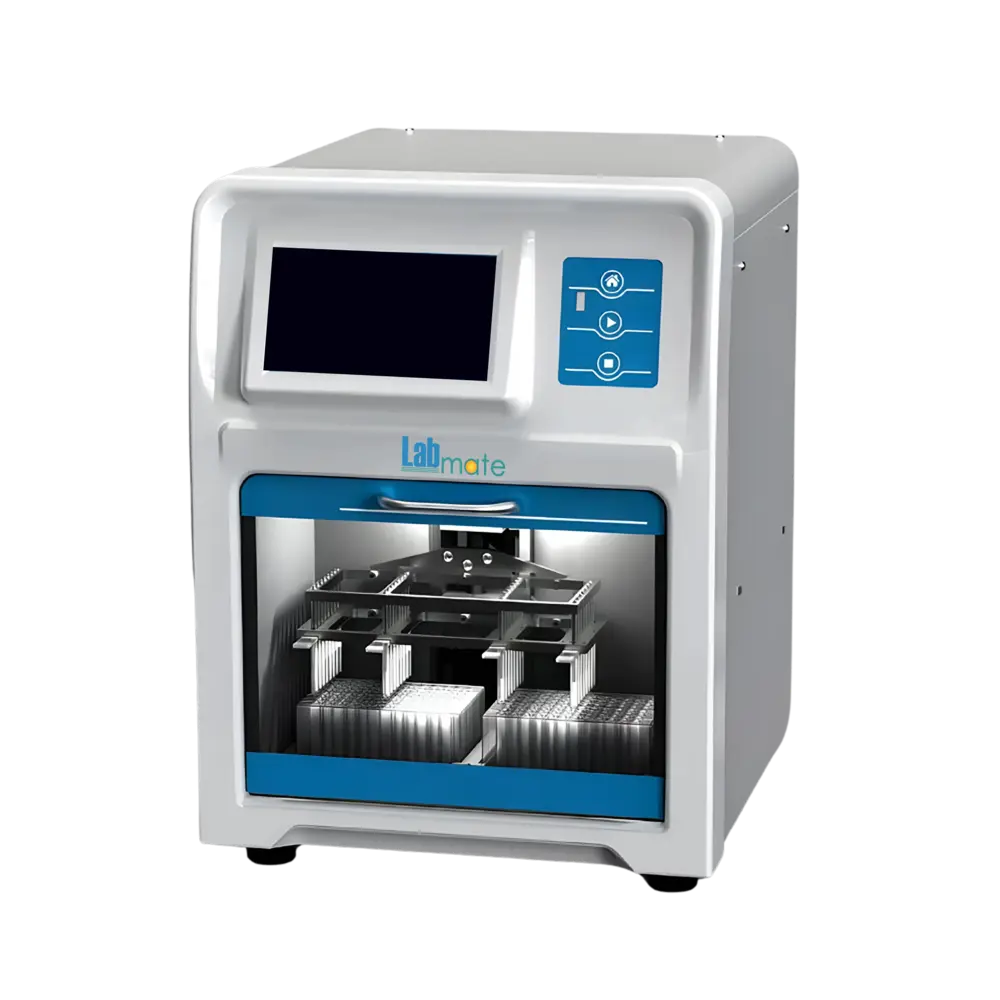
Nucleic Acid Extractor LMNAE-A109 features 32-sample capacity per run, supporting batch processing. It offers an automatic control system that works independently without computer connectivity. Equipped with memory storage, it accommodates 120 program groups, ensuring flexible and repeatable experimental settings. Incorporates vibration mixing with three selectable speeds—slow, middle, and fast—for optimized reagent interaction. Our Nucleic Acid Extractor is ideal for DNA and RNA purification from blood, virus, tissues, cells, bacteria, and plant samples.
Specifications
| Sample Throughput | 1 to 32 |
| Sample Volume | 20 to 1000 µL |
| Lysis Temperature | RT+5 to 120℃ |
| Elution Temperature | RT+5 to 120℃ |
| Magnetic Bead Recovery Rate | Greater than 95% |
| Heating Time | Less than or equal to 5min (from RT to 120℃) |
| Temperature Accuracy | ±1℃ |
| Program Storage Capacity | 120 |
| Preset Programs | 2 |
| Data Storage | built-in SD card |
| Difference Between Extraction Holes | CV less than 5% |
| Plate Types | 96 Deep-well plate |
| Operation Interface | 7-inch touch screen, 3 shortcut buttons |
| Extension Interface | USB, RS232 |
| Lighting System | Yes |
| Disinfection | UV light |
| Fuse | 250V 3A Ф5×20 |
| Power Consumption | 350W |
| Dimensions | 421×377×506 mm |
| Weight | 24 Kg |
Pricing
| Product | Price | Unit | Action |
|---|---|---|---|
| Nucleic Acid Extractor LMNAE-A109 | $ 9212.5 | Each of 1 |
Features
Magnetic separation
High purity
Large touchscreen
Program editing
UV disinfection
Adjustable timing
Safety door
Intelligent operation
Applications
Nucleic Acid Extractor LMNAE-A109 enables efficient DNA and RNA purification from blood, virus, tissues, cells, bacteria, and plant samples in molecular biology, clinical diagnostics, and genetic research laboratories.
Similar Products

$ 7337.5 / Pack of 1

$ 24850 / Pack of 1
$ 10325 / Pack of 1
Frequently Asked Questions
1 What is a Nucleic Acid Extraction System?
A Nucleic Acid Extraction System is an apparatus designed to for isolation, purification and enrichment of nucleic acid.
2 What types of samples can be processed using Nucleic Acid Extraction System?
It is used to process a variety of samples such as blood, tissue, cells and microbial extracts.
3 Is Nucleic Acid Extraction System used in medical testing?
It is commonly used in medical diagnostics to detect infections and genetic testing.
4 Can Nucleic Acid Extraction System be used for different species?
It is used for a variety of species including humans, animals, plants and microorganisms.
5 Can Nucleic Acid Extraction System be used for viruses?
It is used to isolate viral DNA or RNA from infected samples.
6 How does Nucleic Acid Extraction System handle plant samples?
It is specifically optimized to handle plant tissues that contain compounds like polysaccharides or phenols that can inhibit nucleic acid extraction.
7 Can Nucleic Acid Extraction System be used for soil samples?
It is used for extracting DNA or RNA from soil samples.
8 Is Nucleic Acid Extraction System easy to use?
It has user-friendly interface.
9 Can Nucleic Acid Extraction System be used in high-throughput labs?
It ensures rapid analysis therefore is suitable for high-throughput labs.
10 Why is lysis buffer used in Nucleic Acid Extraction System?
It is used to break open cells and release nucleic acids into solution.