

Get Quote
Contact us now to receive a detailed quotation.
Specifications
| Detection Efficiency (³H) | Greater than or equal to 50% |
| Background Count Rate (³H) | Less than or equal to 40 cpm |
| Detection Efficiency (¹⁴C) | Greater than or equal to 90% |
| Background Count Rate (¹⁴C) | Less than or equal to 60 cpm |
| Working Modes | Counting, Quench Correction, DPM Measurement |
| Fitting Methods | 3/2 Equation, Four-Parameter Equation |
| Ambient Temperature Range | 0 ℃ to 45 ℃ |
| Relative Humidity | Less than or equal to 90% (at 40 ℃) |
| Power Consumption | 85 W |
| Dimensions (L×W×H) | 800 mm × 560 mm × 450 mm |
| Packaging Dimensions | 1050 mm × 810 mm × 700 mm |
| Net Weight | 65 Kg |
| Gross Weight | 115 Kg |
Pricing
| Product | Price | Unit | Action |
|---|---|---|---|
| Liquid Scintillation Counter LMSCL-A100 | $ 36650 | Each of 1 |
Features
Automatic Sample Changer
25 sample capacity
Multiple Counting Modes
Counting, quench correction, DPM measurement
Tritium Detection
Efficiency at least 50 percent
Carbon 14 Detection
Efficiency at least 90 percent
Background Count Rate
40 cpm tritium, 60 cpm carbon 14
Quench Curve Fitting
3/2 and four parameter equations
Automatic Data Printing
Dot matrix display with printer
Compact Design
800 x 560 x 450 mm footprint
Standard Accessories
Model No | Accessories | Quantity |
LMSCL-A100-L1 | 20ml low-potassium glass sample bottles | 1 |
LMSCL-A100-P1 | Printing paper | 1 |
LMSCL-A100-R1 | Ribbons | 1 |
LMSCL-A100-U1 | Unquenched Standard Source | 1 |
LMSCL-A100-Q1 | 3H quenching Standard Source | 1 |
LMSCL-A100-Q2 | 14C quenching Standard Source | 1 |
Applications
Applications: Industry | Agriculture | Biomedicine | Molecular Biology | Environmental Science
Functions: Low Energy Beta Nuclide Detection | Radioactive Sample Analysis | Quench Correction | DPM Measurement
Selection Guide
Liquid Scintillation Counter LMSCL-A100 is a high-precision instrument designed for the detection and quantification of low-energy beta-emitting isotopes, such as tritium (³H), carbon-14 (¹⁴C), and sulfur-35 (³⁵S). Based on research studies, it is widely used in radiopharmaceutical research, biochemical assays, environmental monitoring, metabolic studies, and nuclear medicine for detecting trace levels of radioactivity. Its features include automated sample loading, dual-label counting, and quench correction, which enhance accuracy and efficiency in laboratories handling multiple samples. The system is often certified with ISO, CE, and GLP compliance, making it suitable for regulated laboratory environments. These capabilities and certifications help customers select this model for high-throughput, accurate, and compliant liquid scintillation analysis across various scientific disciplines.
Similar Products
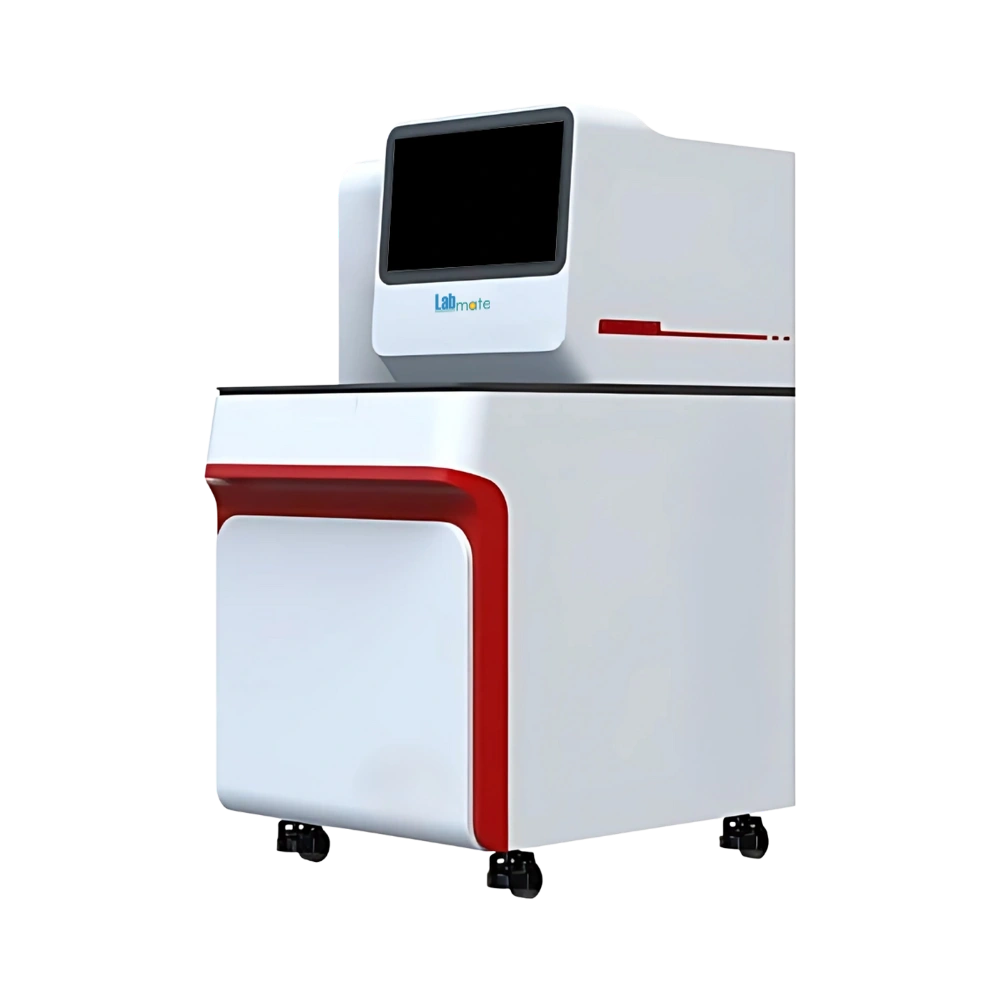
$ 172700 / Each of 1
Frequently Asked Questions
1 What is a Liquid Scintillation Counter?
A Liquid Scintillation Counter is an apparatus designed to detect and measure beta particles emitted by radioactive samples.
2 What is the principle of operation in Liquid Scintillation Counter?
It measures radioactivity by detecting light emitted from a scintillation cocktail upon beta particles absorption.
3 What types of samples can be analyzed using Liquid Scintillation Counter?
It can analyze a variety of samples such as biological, environmental, chemical and radioactive samples.
4 Can Liquid Scintillation Counter be used in high-throughput labs?
It rapidly counts multiple samples therefore is suitable for high-throughput labs.
5 What is the role of the Photomultiplier Tube (PMT) in Liquid Scintillation Counter?
It is used for amplifying the light emitted by the scintillation cocktail upon interaction with beta particles.
6 How is the efficiency of Liquid Scintillation Counter determined?
Its efficiency is determined by calibrating the system using standards with known radioactivity.
7 What is the role of the scintillation cocktail in Liquid Scintillation Counter?
It absorbs the energy from beta particles and re-emits it as light (scintillations) that is detected by photomultiplier tubes to measure the radioactivity.
8 Can Liquid Scintillation Counter detect low-level radioactivity?
It is highly sensitive and can detect trace amounts of radioisotopes.