Get Quote
Contact us now to receive a detailed quotation.
Overview
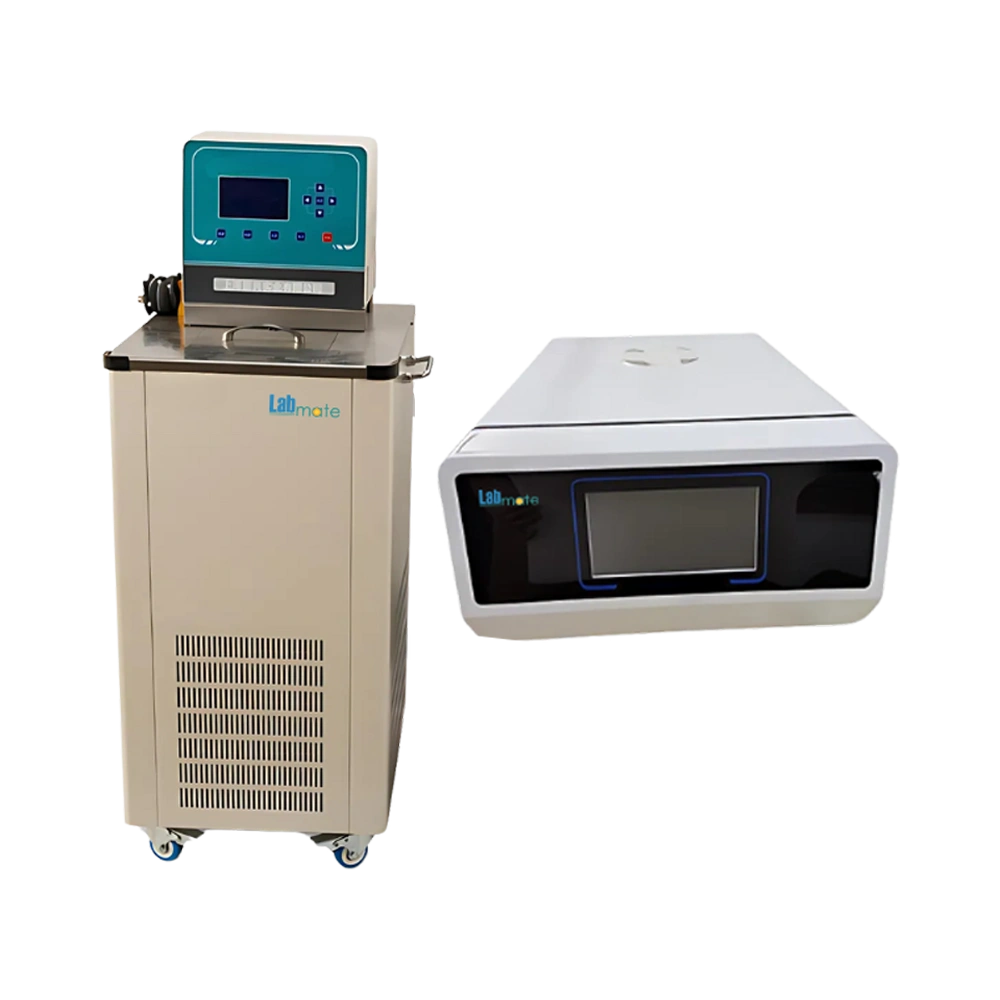
Differential Scanning Calorimeter LMDSC-B101 is equipped with -40 to 600 ℃ temperature range. Its high-sensitivity dual sensors and multi-point calibration enable reliable thermal measurements across various test conditions. It offers fixed and segmented temperature control modes for flexible operation and efficient analysis. Its auto data plotting and USB bidirectional communication simplify result visualization and reporting processes. Our Differential Scanning Calorimeter is ideal for evaluating glass transition, reaction kinetics, and thermal stability.
Features :
High-frequency processor
Optimized PID algorithm
7-inch LCD touchscreen
Independent atmosphere control
Automatic air path switching
Baseline deduction function
Specifications :
| DSC Range | 0 to ±1000 mW |
| Temperature Range | -40 to 600 ℃ |
| Sampling Rate | 1 to 10 Hz (Programmable) |
| Toggle Rate | 16.6 Hz |
| Heating Rate | 0.1 to 100 ℃/min |
| Temperature Resolution | 0.001 ℃ / 0.01 ℃ |
| Temperature Fluctuation | ±0.01 ℃ |
| Temperature Repeatability | ±0.01 ℃ |
| Program Temperature Control | 12-stage |
| Temperature Control Type | Heating, constant temperature, cooling |
| Scan Type | Heating, cooling, isothermal scanning |
| DSC Noise | 0.001 mW |
| DSC Resolution | 0.01 µW |
| DSC Accuracy | 0.001 mW |
| DSC Sensitivity | 0.001 mW |
| Gas flow rate | 0 to 200mL/min |
| Gas pressure | 0.2MPa |
| Power Supply | 220V ,50 Hz |
| Dimension | 2350 × 1100 × 950 mm |
| Gross Weight | 40 Kg |
Standard Accessories :
Model No | Accessory | Unit | Quantity |
LMDSC-B101-H1 | DSC System Host | Set | 1 |
LMDSC-B101-H2 | Power Cord | Each | 1 |
LMDSC-B101-H3 | System Software USB | Each | 1 |
LMDSC-B101-H4 | Data Cable | Each | 1 |
LMDSC-B101-H5 | Aluminum Crucible | Each | 100 |
LMDSC-B101-H6 | Tweezers | Each | 1 |
LMDSC-B101-H7 | Fuses | Each | 5 |
LMDSC-B101-H8 | Trachea | Each | 2 |
LMDSC-B101-H9 | Sample Spoon | Each | 1 |
Applications :
Differential Scanning Calorimeter LMDSC-B101 is ideal for analysing glass transition, crystallization, oxidation induction, melting point, and specific heat changes in advanced material research and industrial quality control.