
Get Quote
Contact us now to receive a detailed quotation.
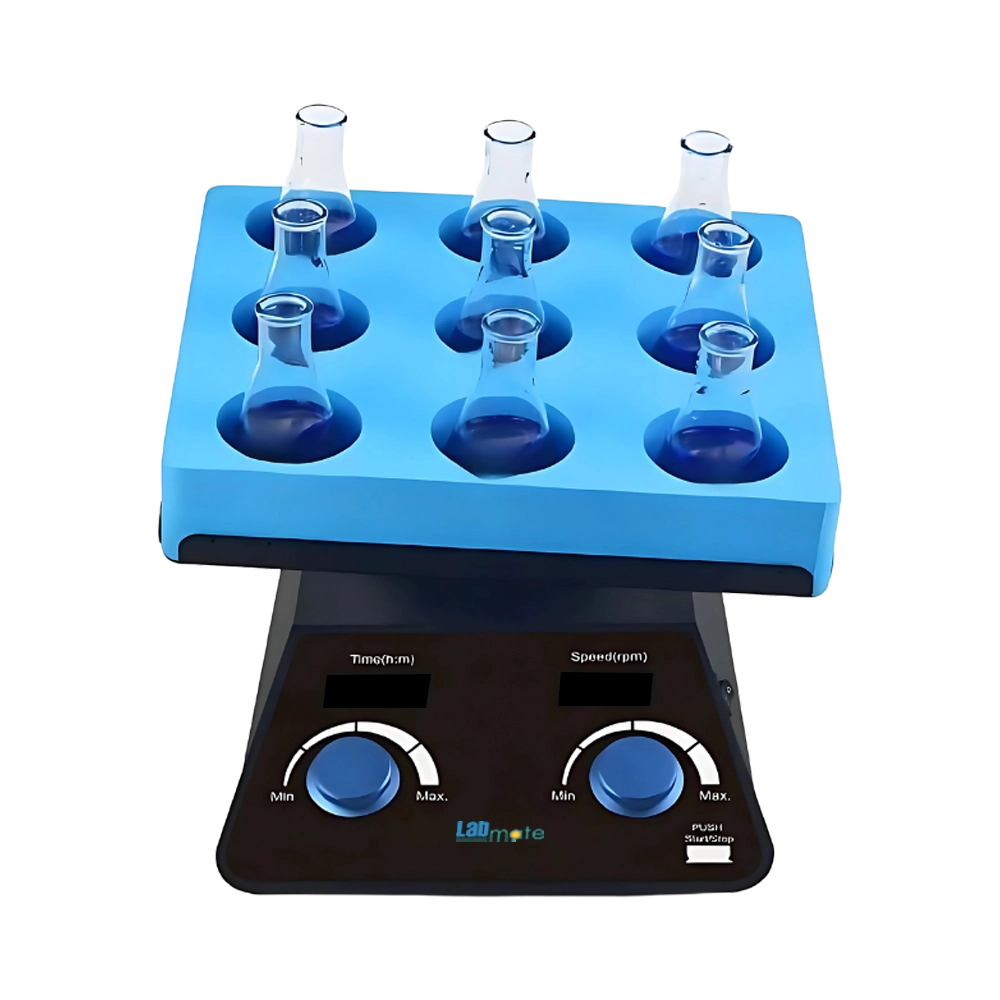
3D Shaker LMSK-A100 operates at a speed range of 5 to 80 rpm. Its adjustable speed control allows smooth agitation. It supports continuous operation for uninterrupted mixing and timed mode for controlled-duration experiments. It accommodates test tubes, culture plates, and conical flasks ensuring versatility. Our 3D Shaker is ideal for electrophoresis gel staining, molecular hybridization, immunoprecipitation, and cell culture.
Specifications
| Speed Range | 5 to 80 rpm |
| Angle of Inclination | 16° |
| Timing Range | 0 to 99h 59min |
| Maximum Load | 2.5 kg |
| Power Consumption | 35 W |
| Dimensions | 368 × 228 × 206 mm |
| Net Weight | 5.2 kg |
Pricing
| Product | Price | Unit | Action |
|---|---|---|---|
| 3D Shaker LMSK-A100 | $ 1687.5 | Each of 1 |
Features
Microcomputer Control Technology
Real-Time Display
Timing Alarm System
Strong Bearing Capacity
Low Running Noise
Optional Accessories
Model No | Accessory | Unit | Quantity |
LMSK-A100-P1 | 4 × 500ml Flask Platform
| Each | 1 |
LMSK-A100-P2 | 5 × 250ml Flask Platform
| Each | 1 |
LMSK-A100-P3 | 9 × 100ml Flask Platform
| Each | 1 |
LMSK-A100-P4 | 2 × Culture Plate Platform
| Each | 1 |
LMSK-A100-P5 | Non-slip Pad | Each | 1 |
LMSK-A100-P6 | Convex Pad | Each | 1 |
Applications
3D Shaker LMSK-A100 is suitable for electrophoresis gel staining, molecular hybridization, immunoprecipitation, protein imprinting, and cell culture.
Similar Products
$ 1937.5 / Each of 1

$ 2762.5 / Each of 1
Frequently Asked Questions
1 What are 3D Shakers?
3D Shakers are laboratory apparatus designed for mixing, blending, and agitation of materials in laboratories, ensuring consistent results across different sample types.
2 How do 3D Shakers differ from Regular Shakers?
3D Shakers offer a unique three-dimensional motion that provides gentle yet thorough mixing, whereas Regular Shakers typically offer only linear or orbital motion.
3 Are 3D Shakers suitable for temperature-sensitive samples?
They are ideal for temperature-sensitive samples because their gentle 3D motion prevents overheating and preserves sample integrity during mixing.
4 Can 3D Shakers be used in cell culture applications?
They are commonly used in cell culture applications where gentle mixing is required to avoid damaging delicate cells.
5 How are 3D Shakers used in DNA extraction?
They are commonly used in DNA extraction to agitate samples gently, ensuring thorough mixing of reagents with cell lysates without causing damage to fragile DNA molecules.
6 Can 3D Shakers be used for protein purification?
They are ideal for protein purification, as their three-dimensional motion ensures proper mixing of buffers and proteins, optimizing the binding and elution processes.
7 Are 3D Shakers suitable for homogenizing tissues in research?
They are effective for homogenizing tissues, as they provide a uniform motion that aids in breaking down the tissue without overheating or degrading sensitive proteins.
8 How do 3D Shakers help in enzyme assays?
They are widely used in enzyme assays, where their consistent agitation ensures even distribution of substrates and enzymes, promoting optimal reaction conditions for accurate results.
9 Can 3D Shakers be used in pharmaceutical formulations?
They are used in pharmaceutical formulations to uniformly mix excipients and active ingredients, ensuring consistent quality and homogeneity in final products like suspensions and emulsions.
10 Can 3D Shakers be used for fermentation processes?
They are highly beneficial in fermentation processes, as their consistent motion improves aeration and nutrient mixing, enhancing the growth of microorganisms or yeast in bioreactors.