

Get Quote
Contact us now to receive a detailed quotation.
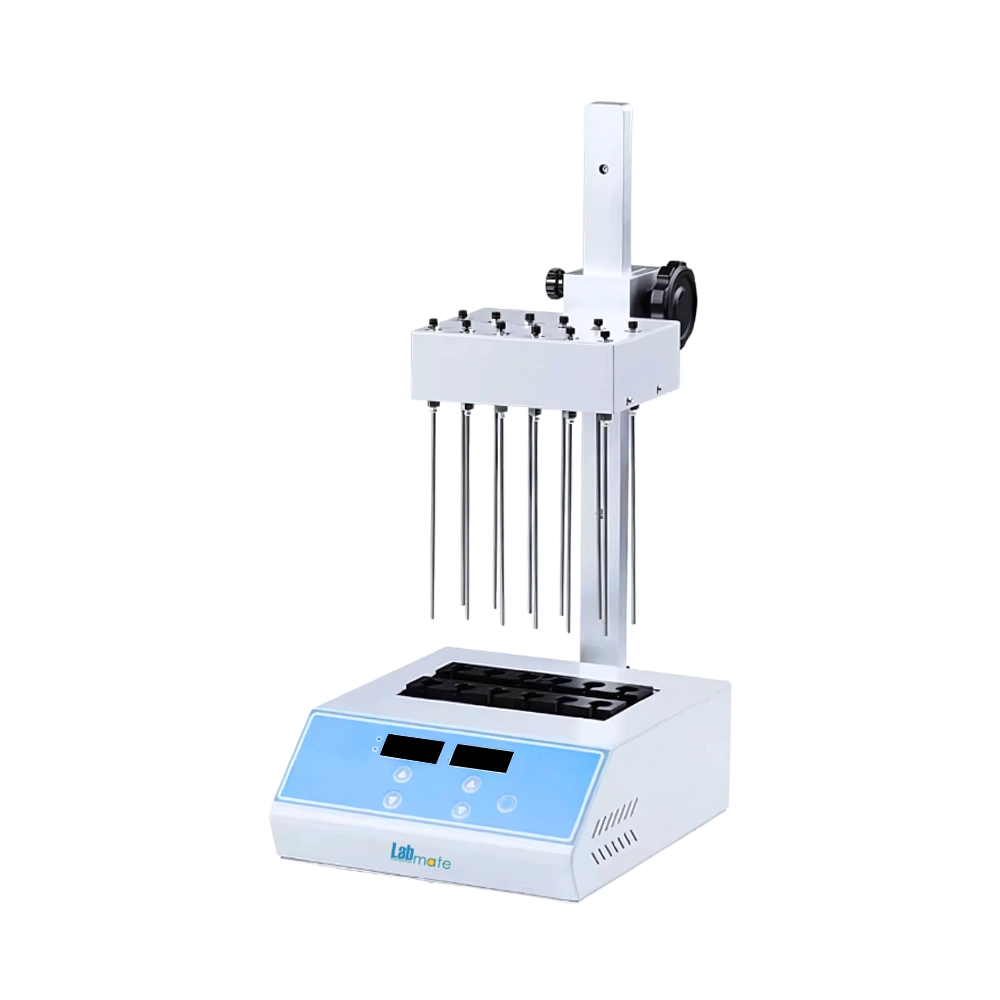
Visible Sample Concentrator LSCC-B101 operates at a temperature range from RT + 5 °C to 150 °C. It is equipped with 1 heating block that provides an efficient and uniform concentration of samples. Our sample concentrator provides a nitrogen flow rate ranging from 0 to 10 L/min, enabling the processing of various types of samples.
Specifications
| Temperature Range | RT + 5 °C - 150 °C |
| Blocks Quantity | 1 Piece |
| Height of gas needle | 150 mm |
| Temperature accuracy ( 40-100 °C) | ± 1 0C |
| Temperature accuracy ( 100-150 °C) | ± 1.5 0C |
| Temperature uniformity (100 °C) | ± 1 0C |
| Nitrogen Flow Rate | 0 - 10 L / min |
| Nitrogen Pressure | ≤ 0.1 mPa |
| Heating Time | ≤ 30 min (from 40 °C to 150 °C) |
| Time Range | 9999 min |
| Dimensions | 310 x 220 x 530 mm |
Pricing
| Product | Price | Unit | Action |
|---|---|---|---|
| Visible Sample Concentrator LSCC-B101 | $ 3837.5 | Pack of 1 |
Features
Incorporated with an overheat prevention system
Features flow-regulated gas needle
Fault alarm functions
Equipped with LED display
Applications
Visible Sample Concentrator is ideal for chemical analysis, pharmaceutical research and development, biological research, environmental testing, and clinical diagnostics.
Optional Blocks
| Model No | Hole Diameter | NO. of Holes | Module Size | Image |
|---|---|---|---|---|
| LSCC-B101-OB1 | 10 mm | 12 | 153.5 x 96 x 49 mm | |
| LSCC-B101-OB2 | 12 mm | 12 | 153.5 x 96 x 49 mm | |
| LSCC-B101-OB3 | 13 mm | 12 | 153.5 x 96 x 49 mm | |
| LSCC-B101-OB4 | 15 mm | 12 | 153.5 x 96 x 49 mm | |
| LSCC-B101-OB5 | 16 mm | 12 | 153.5 x 96 x 49 mm | |
| LSCC-B101-OB6 | 19 mm | 12 | 153.5 x 96 x 49 mm | |
| LSCC-B101-OB7 | 20 mm | 12 | 153.5 x 96 x 49 mm |
Similar Products

$ 3362.5 / Pack of 1
$ 1875 / Each of 1
Frequently Asked Questions
1 What is a Visible Sample Concentrator?
A Visible Sample Concentrator is an apparatus designed to concentrate or evaporate liquid samples while allowing visible observation during the process.
2 How does a Visible Sample Concentrator work?
It works by applying heat, vacuum, and gas flow to remove solvent from samples, allowing for visible monitoring of the concentration process.
3 What types of solvents can Visible Sample Concentrator handle?
It can handle a wide range of volatile organic solvents including methanol, ethanol, and acetonitrile.
4 How is Visible Sample Concentrator used in pharmaceutical testing?
It is used in pharmaceutical testing to concentrate drug formulations and extract active compounds prior to chromatographic analysis.
5 How does Visible Sample Concentrator help in environmental analysis?
It is used in environmental analysis to concentrate pollutants from water or soil extracts for easier detection of trace contaminants.
6 Can Visible Sample Concentrator be used in food safety testing?
It is used in food safety testing to reduce sample volumes of food extracts before screening for pesticides or toxins.
7 How is Visible Sample Concentrator applied in forensic science?
It is used in forensic science to concentrate biological fluids or chemical residues for DNA analysis or toxicology screening.
8 What role does Visible Sample Concentrator play in clinical diagnostics?
It is used in clinical diagnostics to prepare patient samples for biomarker detection or therapeutic drug monitoring.
9 Is Visible Sample Concentrator useful in metabolomics research?
It is used in metabolomics research to concentrate biological samples such as plasma or urine before mass spectrometry analysis.
10 How can Visible Sample Concentrator help in nanomaterial synthesis?
It is used in nanomaterial synthesis to remove solvents during the purification or post-synthesis processing of nanoparticles.