

Get Quote
Contact us now to receive a detailed quotation.
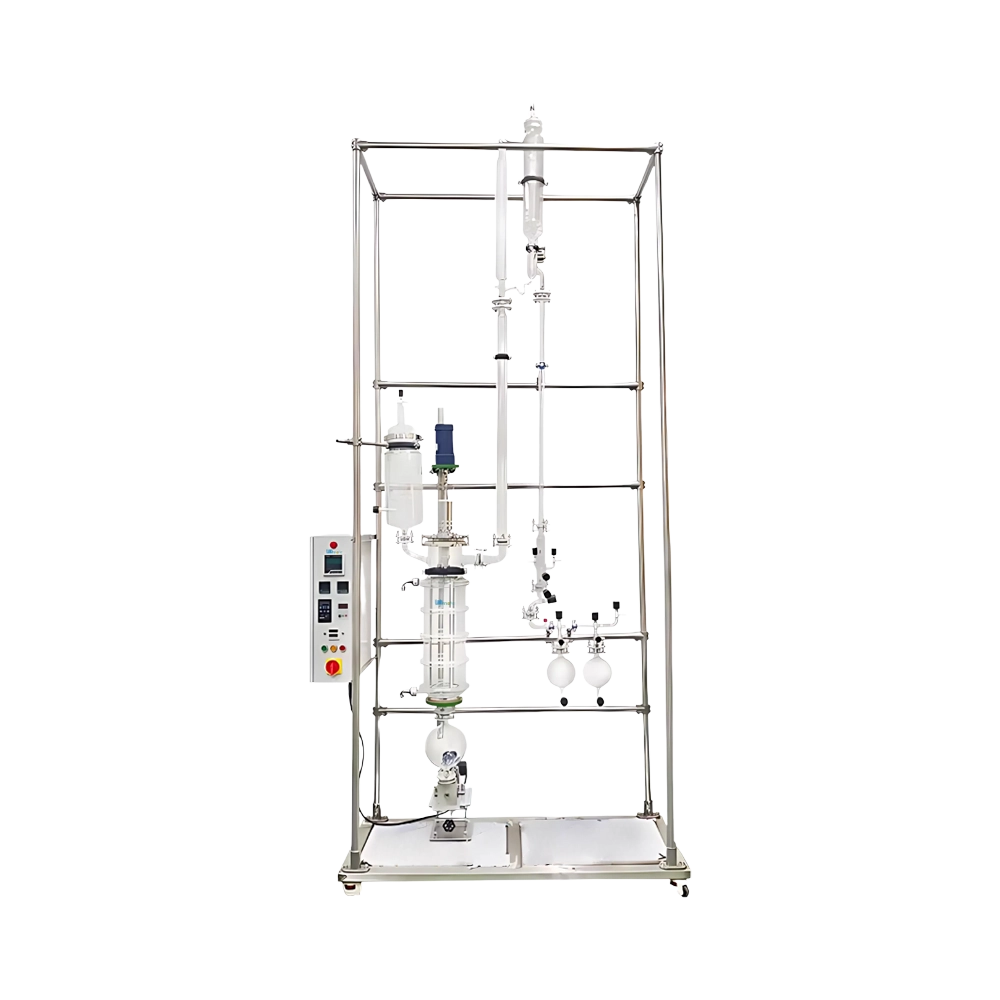
Thin Film Distillation Column LMTFD-A104 is engineered with 5-liter tank capacity. It enables high-efficiency evaporation, handling high-boiling materials at lower temperatures. Equipped with film scraper, it forms turbulent liquid film for efficient separation. Integrated master control box allows adjustments of rotational speed, reflux ratio, and vacuum settings. Our Distillation Column is ideal for concentration and solvent recovery in chemical industries.
Specifications
| Capacity | 5 L |
| Working Temperature | Less than or equal to 300°C |
| Pressure | Less than or equal to 1 mbar |
| Rotation Speed Range | 50 to 500 rpm |
| Condenser Area | 0.5 m² |
| Material | High borosilicate 3.3 glass |
| Height | 2 m |
Pricing
| Product | Price | Unit | Action |
|---|---|---|---|
| Thin Film Distillation Column LMTFD-A104 | $ 59650 | Each of 1 |
Features
Enhanced product purity
Reduced purification steps
Continuous feeding process
Minimal material degradation
Optimized heat transfer
Small installation footprint
Applications
Thin Film Distillation Column LMTFD-A104 is employed for concentration, purification solvent recovery of heat-sensitive and high-boiling materials in pharmaceutical, food, and chemical settings.
Selection Guide
Thin Film Distillation Column LMTFD-A104 is perfect for specialized distillation processes in chemical, pharmaceutical, and research laboratories. Based on various research studies, this model is particularly used for purifying heat-sensitive, viscous, or high-boiling compounds. Its design supports continuous and efficient separation under high vacuum, making it suitable for applications like solvent recovery, cannabinoid purification, and essential oil refinement. It is often used in pilot-scale experiments and small production runs. It complies with international standards and typically includes CE certification, ensuring operational safety and reliability. Customers looking for a system with excellent thermal efficiency, reduced residence time, and consistent performance under vacuum will find this model an optimal choice.
Similar Products

$ 72000 / Each of 1

$ 49237.5 / Each of 1

$ 42475 / Each of 1
$ 54237.5 / Each of 1

$ 45850 / Each of 1
Frequently Asked Questions
1 What is a Thin Film Distillation Column?
A Thin Film Distillation Column is an apparatus designed to separate heat-sensitive liquids by spreading them into a thin film on a heated surface under vacuum.
2 How does Thin Film Distillation Column work?
It works by spreading liquid into a thin film on a heated surface, where volatile components evaporate under vacuum and are condensed separately.
3 What kind of maintenance does Thin Film Distillation Column require?
Routine maintenance includes regular cleaning, vacuum checks, and maintenance of seals, bearings, and heating components.
4 Is Thin Film Distillation Column suitable for essential oil refinement?
It is ideal for refining essential oils by separating delicate aroma compounds without damaging their properties.
5 How is Thin Film Distillation Column used in the pharmaceutical industry?
It is used to concentrate, purify, or recover heat-sensitive pharmaceutical intermediates and active ingredients.
6 Can Thin Film Distillation Column process high-viscosity materials?
It is specifically engineered to handle viscous or sticky materials such as waxes, polymers, and resins due to its mechanical film-forming action.
7 Can Thin Film Distillation Column be used in the food industry?
It is used for decolorization, deodorization, and refining of oils, vitamins, and flavor extracts while preserving nutrients.
8 Can Thin Film Distillation Column be used for solvent recovery?
It efficiently separates and recovers valuable solvents from reaction mixtures or waste streams.
9 Can Thin Film Distillation Column be used for polymer purification?
It is used to remove monomers, solvents, and low-molecular-weight fractions from polymers like silicone or polyesters.
10 Can Thin Film Distillation Column be used in vitamin production?
It is used to purify temperature-sensitive vitamins like A, D, and E by removing by-products and stabilizing the final compound.