
Get Quote
Contact us now to receive a detailed quotation.
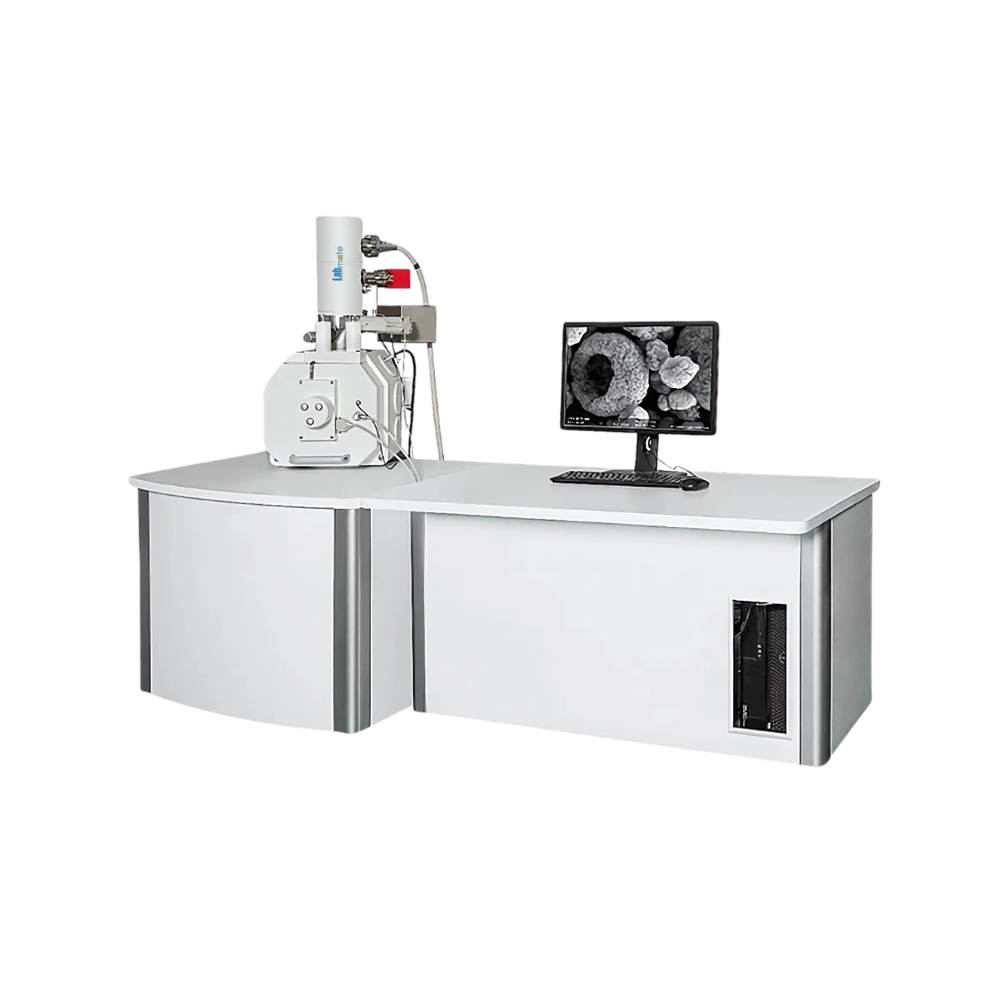
Scanning Electron Microscope LMSEM-A100 delivers magnification range of 2x to 1,600,000x. It provides high-resolution imaging for detailed analysis of micro and nano-scale structures. Equipped with advanced electron optics for definite visualization and reliability. Integrated with an ergonomic design and user-friendly interface for seamless operation. Our Microscope is ideal for material science, life science, and industrial research.
Specifications
| Magnification | 2x to 1,600,000x |
| Resolution | 0.9 nm to 30 nm |
| Electron Gun Type | Schottky field emission gun |
| Lifespan of Gun | 15,000 hours |
| Lens System | Multilevel high-performance conical objective system |
| Objective Aperture | Three objective apertures |
| Vacuum System | 2 ion pumps, 1 turbo molecular pump (TMP), 1 mechanical pump |
| Detectors | High vacuum SE detector, integrated BSE detector, IRCCD |
| Stage | Five-axis motorized eucentric stage (X: 150 mm, Y: 150 mm, Z: 65 mm, T: -10° to +90°, R: 360°) |
| Image Display | Real-time magnification display, grey curve, scale plate, and frame averaging |
| Operating Temperature | 16 to 30°C |
| Operating Humidity | < 60% |
| Noise | < 68 dB |
| Image Format | TIF, BMP, GIF, JPG, PNG |
| Maximum Display Size | 16,384×16,384 pixels |
| Power Consumption | AC 220V, 50 Hz |
| Sample Size | 320×80 mm |
| Microscope Dimension | 800×800×1480 mm |
| Working Table Dimension | 1340×850×740 mm |
| Weight | 450 kg |
Pricing
| Product | Price | Unit | Action |
|---|---|---|---|
| Scanning Electron Microscope LMSEM-A100 | $ 450150 | Each of 1 |
Features
Brightness and contrast adjustment
Autofocus
Fast scanning
Electron beam
Frame averaging function
Applications
Scanning Electron Microscope LMSEM-A100 is ideal for material science, life sciences, and industrial research. It enables detailed surface morphology studies, quality control in manufacturing, and failure analysis.
Frequently Asked Questions
1 What is a Scanning Electron Microscope?
A Scanning Electron Microscope is an apparatus designed to use focused beam of electrons to create high-resolution images of the surface of a sample.
2 How does Scanning Electron Microscope work?
It works by scanning a sample with a focused beam of electrons that interact with the atoms in the sample, producing signals that provide information about the surface topography and composition.
3 How is Scanning Electron Microscope used in materials science?
In materials science, it is used to analyze microstructures, detect surface defects, and study fracture patterns in metals, ceramics, polymers, and composites.
4 Can Scanning Electron Microscope be used in semiconductor analysis?
It is essential in semiconductor analysis for inspecting microchips, identifying layer defects, and measuring feature dimensions at the nanoscale.
5 How does Scanning Electron Microscope help in forensic investigations?
In forensic science, it is used to analyze trace evidence such as gunshot residue, hair, fibers, and tool marks, providing high-resolution imaging for criminal investigations.
6 What role does Scanning Electron Microscope play in biological research?
It is used in biological research to visualize the detailed surface structure of cells, tissues, and microorganisms after proper preparation and coating.
7 How is Scanning Electron Microscope applied in nanotechnology?
In nanotechnology, it is crucial for characterizing nanoparticles, nanowires, and nano-patterned surfaces with extreme precision and high magnification.
8 Can Scanning Electron Microscope be used in pharmaceutical research?
It is used in pharmaceutical research to examine the morphology of drug particles, tablet coatings, and delivery systems for improved formulation.
9 How is Scanning Electron Microscope used in metallurgy?
It is used in metallurgy to examine grain boundaries, phase distribution, and surface features of metals to assess their structural integrity and performance.
10 Can Scanning Electron Microscope be used in food science?
It is used in food science to analyze food microstructures, packaging surfaces, and ingredient distribution to enhance product quality and shelf life.