
Get Quote
Contact us now to receive a detailed quotation.
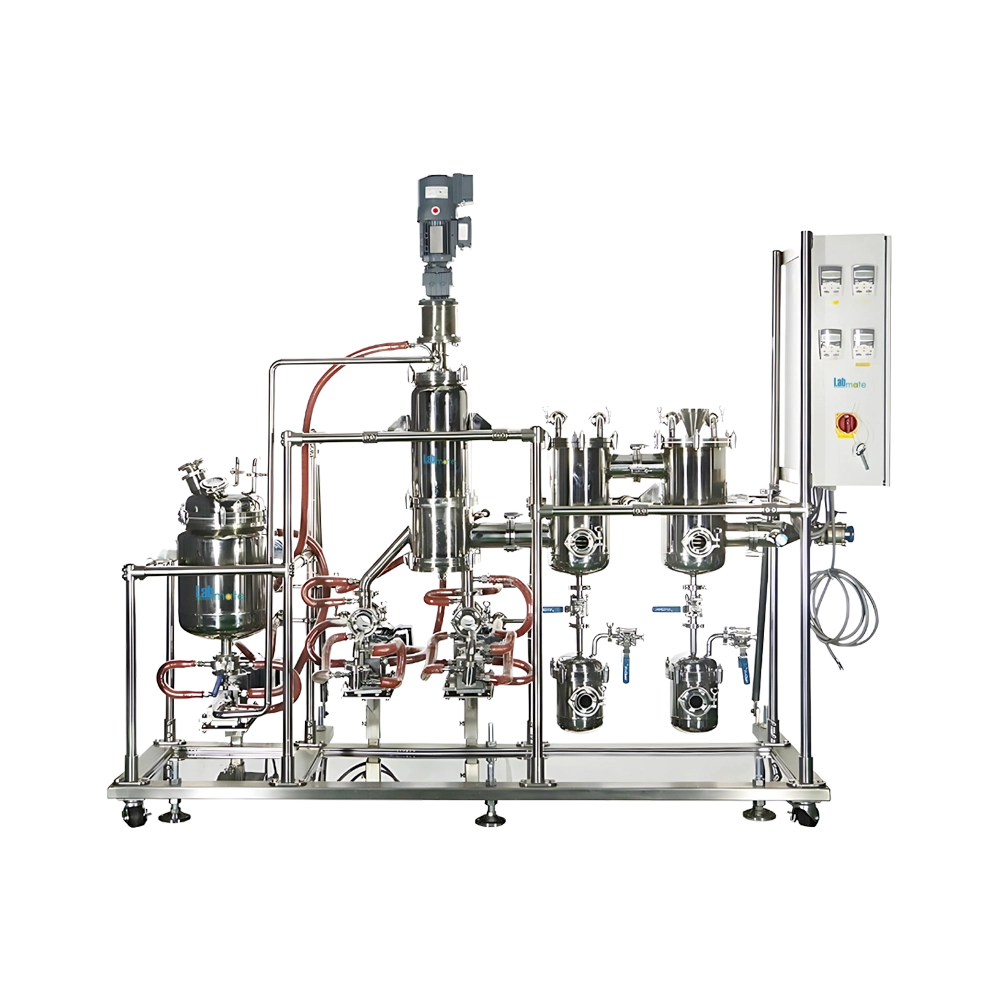
Molecular Distillation Unit LMMDU-A106 offers 5 to 20 L/h. It features durable material for heat transfer, corrosion resistance, and effortless cleaning. Equipped with standard interface connections for external condensers, heating, and refrigeration units. Integrates sight glass on feed tank and discharge port, allowing monitoring. Our Distiller ensures purification of chemicals, medicines, food, beverages, and petroleum products.
Specifications
| Feeding Rate | 5 to 20 L/h |
| Feeding Flask Volume | 15 L |
| Operating Temperature | Less than or equal to 350°C |
| Vacuum Level | Less than or equal to 0.01 millibar |
| Material | Stainless steel 316L |
| Evaporation Area | 0.2 m² |
| Dimensions | 2580×900×2050mm |
Pricing
| Product | Price | Unit | Action |
|---|---|---|---|
| Molecular Distillation Unit LMMDU-A106 |
Features
Automatic feeding/discharging pump
Full jacket insulation
Blockage prevention
Magnetic coupling seal
Stable vacuum system
Polished inner wall
Fluororubber sealing
Applications
Molecular Distillation Unit LMMDU-A106 is ideal for separation, purification, and concentration in chemical, pharmaceutical, food, beverage, and petroleum industries for polymers, medicines, dairy, juices, syrups, lubricants, and solvents.
Selection Guide
Molecular Distillation Unit LMMDU-A106 is an advanced system designed for high-throughput processing and efficient separation of thermally sensitive and high-boiling-point compounds. With a feeding rate of 5 to 20 L/h and a large 15 L feeding flask, it is well-suited for industrial-scale operations in pharmaceuticals, nutraceuticals, petrochemicals, and cannabinoid refinement. Its ability to operate at temperatures up to 350°C and achieve a vacuum level of ≤0.01 millibar ensures optimal separation of complex mixtures while preserving compound integrity. The unit complies with international standards such as ISO and CE, making it suitable for GMP-certified environments. Researchers and professionals seeking efficient purification of heat-sensitive substances in large volumes can rely on this model for consistent performance, process scalability, and regulatory compliance.
Similar Products

$ 28587.5 / Each of 1
$ 34100 / Each of 1

$ 24487.5 / Each of 1
$ 80275 / Each of 1

$ 194575 / Each of 1

$ 117650 / Each of 1
$ 40750 / Each of 1

$ 250575 / Each of 1
$ 28137.5 / Each of 1
$ 177150 / Each of 1
$ 99450 / Each of 1
Frequently Asked Questions
1 What is a Molecular Distillation Unit?
A Molecular Distillation Unit is an apparatus designed to separate and purify heat-sensitive compounds at low temperatures.
2 How does Molecular Distillation Unit work?
It works by applying high vacuum and low temperature to separate compounds based on their molecular evaporation rates.
3 What types of materials can be processed using Molecular Distillation Unit?
It can process materials that are heat-sensitive and have high boiling points, such as fatty acids, vitamins, steroids, pharmaceutical drugs, chemicals and solvents.
4 Can Molecular Distillation Unit be used for large-scale production?
It can be scaled up for industrial applications, allowing for continuous and large-volume processing.
5 What kind of maintenance does Molecular Distillation Unit require?
Regular maintenance includes cleaning of the evaporator, condenser and vacuum system, checking for leaks, replacing seals and ensuring that the vacuum pump is operating efficiently.
6 Is Molecular Distillation Unit suitable for separating volatile compounds?
It is highly effective at separating volatile compounds from non-volatile impurities.
7 Can Molecular Distillation Unit handle both liquid and viscous materials?
It can process both liquid and viscous materials.
8 Can Molecular Distillation Unit be used to extract natural products?
It is commonly used in the extraction of natural products such as essential oils from plants, cannabinoids from cannabis and fatty acids from fish oils.
9 What role does evaporator play in Molecular Distillation Unit?
It is responsible for heating the material under a vacuum to its evaporation point, allowing for separation of volatile and non-volatile components.
10 Can Molecular Distillation Unit be used to purify waste materials?
It is used to purify waste streams by separating valuable compounds from impurities in chemical and environmental processing.