

Get Quote
Contact us now to receive a detailed quotation.

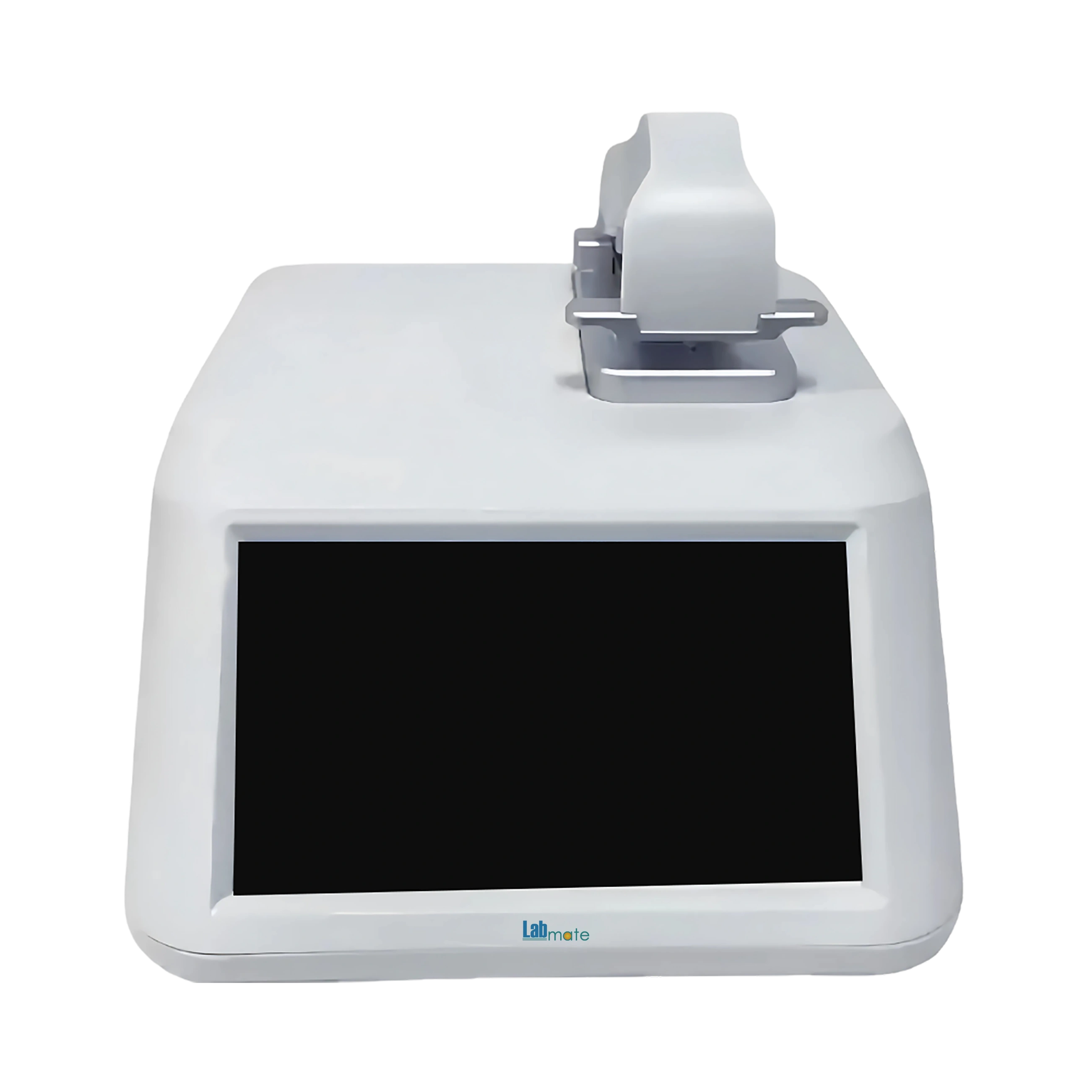

Micro Spectrophotometer LMMS-A900 operates at a wavelength range of 180 to 910 nm. It features Android operating system with 7-inch touch screen for intuitive operation. Its measurement requires no dilution, with results displayed clearly and easily. It requires only 0.5–2 μL of sample, making it ideal for limited or precious specimens. Its long- delivers stable performance with up to 10⁹ flashes. Our Micro Spectrophotometer is ideal for rapid quantification of DNA, RNA, and proteins
Specifications
| Sample Volume | 0.5 to 2.0 µL |
| Wavelength Range | 180 to 910 nm |
| Cuvette Measurement (OD600) | 600 ± 8 nm |
| Nucleic Acid Range | dsDNA: 2 to 15000 ng/µL, ssDNA: 1.32 to 9900 ng/µL, RNA: 1.6 to 12000 ng/µL |
| Protein Detection Range | A280: 0.04 to 300 mg/mL, BSA: 0.06 to 447.76 mg/mL, IgG: 0.03 to 218.98 mg/mL, Lysozyme: 0.015 to 113.64 mg/mL |
| Path Length | 0.05 mm, 0.2 mm, 1 mm |
| Absorbance Range (10 mm equivalent) | 0.04 to 300 A |
| Absorbance Accuracy | ±1% (7.332 Abs at 260 nm) |
| Absorbance Precision | 0.002 Abs |
| Wavelength Accuracy | ±1 nm |
| Wavelength Precision | ±0.2 nm |
| Cuvette Absorbance Range | 0 to 4.000 Abs |
| Cuvette Absorbance Stability | (0 to 3) Less than or equal to 0.5%, (3 to 4) Less than or equal to 1.5% |
| Cuvette Absorbance Repeatability | (0 to 2) Less than or equal to 0.005 A, (2 to 3) Less than or equal to 1%, (3 to 4) Less than or equal to 2% |
| Spectral Resolution | Less than or equal to 1.5 nm |
| Measurement Time | Less than 6 s |
| Detector | 2048-element linear CMOS array |
| Sample Pedestal | 304 Stainless steel and Quartz fibre |
| Data Export | USB |
| Power Consumption | 48 W |
| Power Supply | 12V, 4A |
| Dimensions | 270 × 210 × 196 mm |
| Weight | 3.4 kg |
Pricing
| Product | Price | Unit | Action |
|---|---|---|---|
| Micro Spectrophotometer LMMS-A900 | $ 8125 | Pack of 1 |
Features
Xenon flash lamp
USB data export
Image output
Excel table output
Small sample volume
Sample recovery
Applications
Micro Spectrophotometer LMMS-A900 is ideal for rapid quantification of DNA, RNA, and proteins in academic, clinical, molecular biology and life science research.
Selection Guide
Micro-Spectrophotometer LMMS-A900 is a compact, high-precision device designed for advanced applications in molecular biology, biochemistry, and life science research. With a broad wavelength range of 180 to 910 nm and a wavelength accuracy of ±1 nm, it enables reliable measurement of nucleic acids, proteins, and microbial density, including OD600 (600±8 nm) for bacterial growth analysis. The instrument supports micro-volume samples ranging from 0.5 to 2.0 μl, making it perfect for labs working with limited or precious samples. Its sample pedestal is made of 304 stainless steel and quartz fiber, providing excellent chemical resistance and durability. Commonly used in research studies and certified for quality and accuracy, the model is well-suited for academic, pharmaceutical, and diagnostic laboratories requiring reproducible, high-quality absorbance results.
Similar Products

$ 11137.5 / Each of 1

$ 9100 / Each of 1

$ 7937.5 / Pack of 1

$ 9300 / Pack of 1
Frequently Asked Questions
1 What is a Micro-Spectrophotometer?
A Micro-Spectrophotometer is an apparatus designed to combine microscopy and spectrophotometry to measure the spectral properties of microscopic samples.
2 How does a Micro-Spectrophotometer work?
It works by focusing light onto a tiny area of a sample and analyzing the spectrum of light absorbed, transmitted, or reflected from that area.
3 What types of samples can be analyzed using Micro-Spectrophotometer?
It can analyze a wide range of samples including biological tissues, inks, fibers, thin films, and microelectronic components.
4 How is Micro-Spectrophotometer used in forensic science?
It is used in forensic science to analyze trace evidence such as textile fibers, inks, and paint chips by measuring their spectral properties without destroying the sample.
5 What role does Micro-Spectrophotometer play in pharmaceutical research?
It plays a critical role in pharmaceutical research by enabling the analysis of drug compounds and uniformity of active ingredients in micro-scale tablet samples.
6 Is Micro-Spectrophotometer useful in environmental science?
It is useful in environmental science for analyzing micro-contaminants on surfaces and identifying the spectral signatures of particulate matter.
7 How is Micro-Spectrophotometer applied in the textile industry?
In textile industry, it is used to assess color consistency and dye uniformity in fabrics at the microscopic level.
8 Can Micro-Spectrophotometer be used in biomedical research?
It is widely used in biomedical research to study cells, tissues, and microarrays for their optical and biochemical properties.
9 How does Micro-Spectrophotometer benefit quality control in manufacturing?
It enhances quality control in manufacturing by providing precise color and material analysis on production samples and micro-features.
10 Can Micro-Spectrophotometer be used for food safety testing?
It can be used in food safety testing to detect contaminants, colorants, or degradation products in food samples with micro-level precision.