
Get Quote
Contact us now to receive a detailed quotation.
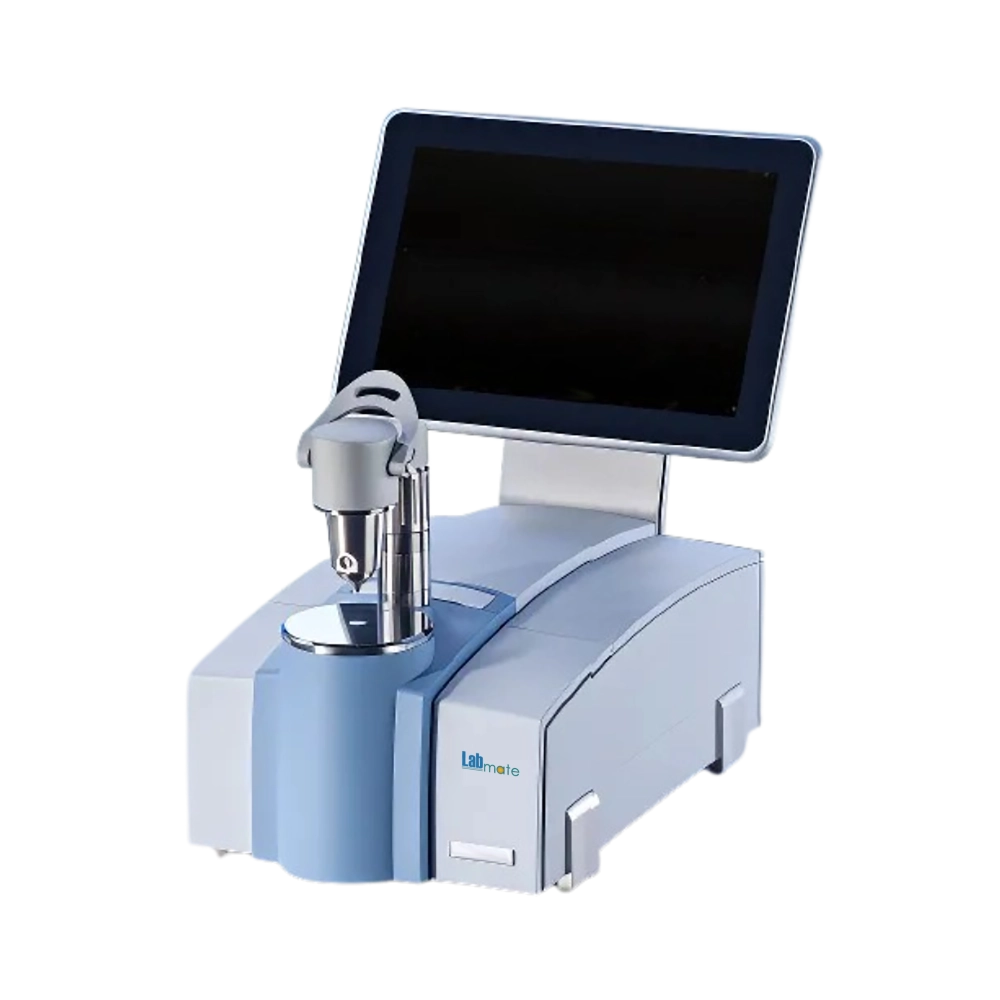
FTIR Spectrometer LMFS-B100 has spectral range of 8000 to 350 cm⁻¹. It features highly stable interferometer and long-lasting IR source. Equipped with high-sensitivity detector for optimal signal detection. Incorporated with user-friendly interface for seamless operation. Our Spectrometer is ideal for material identification and molecular structure analysis.
Specifications
| Spectral Range | 8,000 to 350 cm⁻¹ |
| Spectral Resolution | 0.75 cm⁻¹ |
| Interferometer | RockSolid with gold mirrors, high throughput, permanent alignment |
| Laser Type | Diode laser |
| IR Source | CenterGlow technology for optimized light flux |
| Detector | DTGS and temperature-controlled |
| Optics | Sealed and desiccated |
| Work Disk Material | Stainless steel |
| Pressure Applicator | Slip clutch high-pressure applicator |
| Weight | 7 kg |
Pricing
| Product | Price | Unit | Action |
|---|---|---|---|
| FTIR Spectrometer LMFS-B100 | $ 56125 | Each of 1 |
Features
Diode-based system
Regulatory Compliance
Compact Design
Fast Analysis
Standard Accessories
Accessory | Unit | Quantity |
Desiccant | Each | 1 |
Polymer Spectra Library | Each | 1 |
Set Of Tools | Each | 1 |
Touch Panel Computer With OPUS-TOUCH Software | Each | 1 |
OPUS/SEARCH Software Package | Each | 1 |
Optional Accessories
Model No. | Accessory | Unit | Quantity |
LMFS-B100-T1 | Trolley | Each | 1 |
LMFS-B100-C1 | Carrying Case | Each | 1 |
LMFS-B100-S2 | Smart cloud storage device | Each | 1 |
Applications
FTIR Spectrometer LMFS-B100 is vital for raw material identification, quality control, counterfeit drug detection in pharmaceuticals, and pollutant analysis in air, water, and soil environments.
Selection Guide
FTIR Spectrometer LMFS-B100 is suitable for advanced analytical research and routine laboratory applications. With a broad spectral range of 8,000 to 350 cm⁻¹ and a high spectral resolution of 0.75 cm⁻¹, this instrument is suitable for identifying organic and inorganic compounds, studying molecular structures, and conducting quantitative analysis in pharmaceuticals, polymers, chemicals, and environmental testing. The Rock-solid interferometer with gold mirrors ensures high optical throughput and long-term stability due to its permanent alignment, making it reliable for high-precision research studies. The integrated diode laser provides consistent wavelength calibration, enhancing measurement accuracy. Customers should consider this model if their requirements include advanced materials analysis, regulatory compliance, and experiments that demand long-term reliability, accurate resolution, and consistent performance across a wide spectral range.
Similar Products
$ 43750 / Each of 1

$ 31962.5 / Each of 1
Frequently Asked Questions
1 What is a FTIR Spectrometer?
A FTIR Spectrometer is a laboratory apparatus that utilizes infrared radiation to identify and characterize the chemical composition of solid, liquid and gas samples.
2 On what principle is FTIR Spectrometer based upon?
It is based on the interaction between infrared light and the molecular bonds within a sample thereby providing valuable insights into its structural and functional properties.
3 What types of samples can be analyzed using FTIR Spectrometer?
It can analyze wide range of samples including powders, crystals, thin films, solvents, oils and gases.
4 Why is Fourier Transform used in FTIR Spectrometer?
It is used to convert the time-domain data into frequency-domain data (spectrum).
5 What is the difference between FTIR Spectrometer and NMR?
FTIR Spectrometer detects vibrations of chemical bonds in a sample by measuring infrared absorption whereas NMR analyzes the magnetic properties of atomic nuclei.
6 What is meant by signal-to-noise ratio in FTIR Spectrometer?
It refers to the proportion of the signal compared to the background noise.