
Get Quote
Contact us now to receive a detailed quotation.
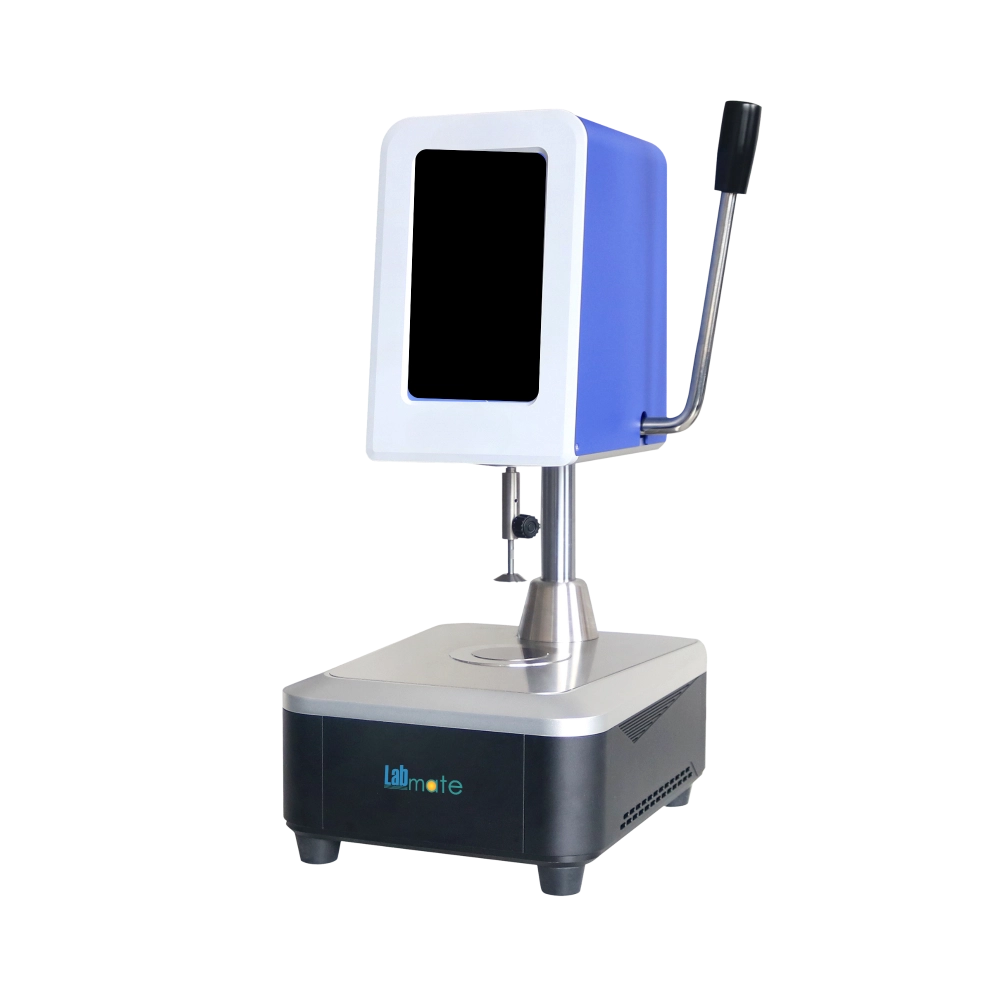
Cone and Plate Viscometer LMPV-A100 features measurement range of 20 to 37,500 mPa.s. It offers wide shear rate range and an advanced reliability temperature control system. Equipped with user-friendly interface that ensures smooth operation. Integrated with spindle fixing screw that enables secure spindle attachment. Our Viscometer is ideal for analyzing liquid viscosity in research and industrial settings.
Specifications
| Measurement Range | 20 to 37,500 mPa.s |
| Speed Range | 5 rpm to 1000 rpm |
| Measurement Error | Less than 2% of full scale |
| Sample Volume | Less than 2 ml |
| Temperature Control Type | Low-Temperature (L Type): 5℃ to 75℃ High-Temperature (H Type): 50℃ to 235℃ |
| Temperature Resolution | 0.1℃ |
| Temperature Control Accuracy | ±0.5℃ (L Type) ±1℃ (H Type, set temp less than 150℃) ±2℃ (H Type, set temp greater than 150℃) |
| Dimension | 22×28×48 cm |
| Packing Dimension | 63×42×38 cm |
| Weight | 12 Kg |
| Gross Weight | 14 Kg |
Pricing
| Product | Price | Unit | Action |
|---|---|---|---|
| Cone and Plate Viscometer LMPV-A100 | $ 16350 | Each of 1 |
Features
7-inch touch screen
Menu operation
Durable metal shell
Linear calibration
Over-range alarm
USB data export
Rheological analysis software
Standard Accessories
Standard oil and spindle
Applications
Cone and Plate Viscometer LMPV-A100 ensures reliable viscosity measurement for paints coatings and emulsions. It supports quality control in pharmaceuticals food processing and petrochemical industries.
Frequently Asked Questions
1 What is a Cone and Plate Viscometer?
A Cone and Plate Viscometer is an apparatus designed to measure the viscosity of fluids with high precision by analyzing the torque required to rotate a cone against a stationary plate.
2 How does Cone and Plate Viscometer work?
It works by measuring the torque needed to rotate a cone over a flat plate with a fluid sample in between.
3 Can Cone and Plate Viscometer test biological fluids?
It is used to test biological fluids such as blood plasma or synovial fluid to study their rheological properties in medical research.
4 Can Cone and Plate Viscometer be used to study lubricant performance?
It is used to study lubricant performance by measuring viscosity under varying shear and temperature conditions.
5 How does Cone and Plate Viscometer support drug delivery research?
It supports drug delivery research by analyzing the flow behavior of suspensions, emulsions, and gels that influence bioavailability and spreadability.
6 Is Cone and Plate Viscometer suitable for quality assurance in dairy products?
It is suitable for quality assurance in dairy products like yogurt and cream to maintain consistent texture and mouthfeel.
7 Can Cone and Plate Viscometer support stability studies in formulation labs?
It supports stability studies by detecting viscosity changes over time, indicating potential degradation or phase separation in formulations.
8 How is Cone and Plate Viscometer used in rheological profiling during material research?
It is used in rheological profiling to study flow and deformation behaviors of new materials under various shear rates in controlled lab conditions.
9 How does Cone and Plate Viscometer contribute to reproducibility in lab-scale viscosity testing?
It contributes to reproducibility by using standardized geometries and precise torque measurement to yield consistent results across tests and users.
10 Is Cone and Plate Viscometer used for determining the viscosity of oral suspensions?
It is commonly used to determine the viscosity of oral suspensions to ensure proper mouthfeel, redispersibility, and stability during storage.