Get Quote
Contact us now to receive a detailed quotation.
Overview
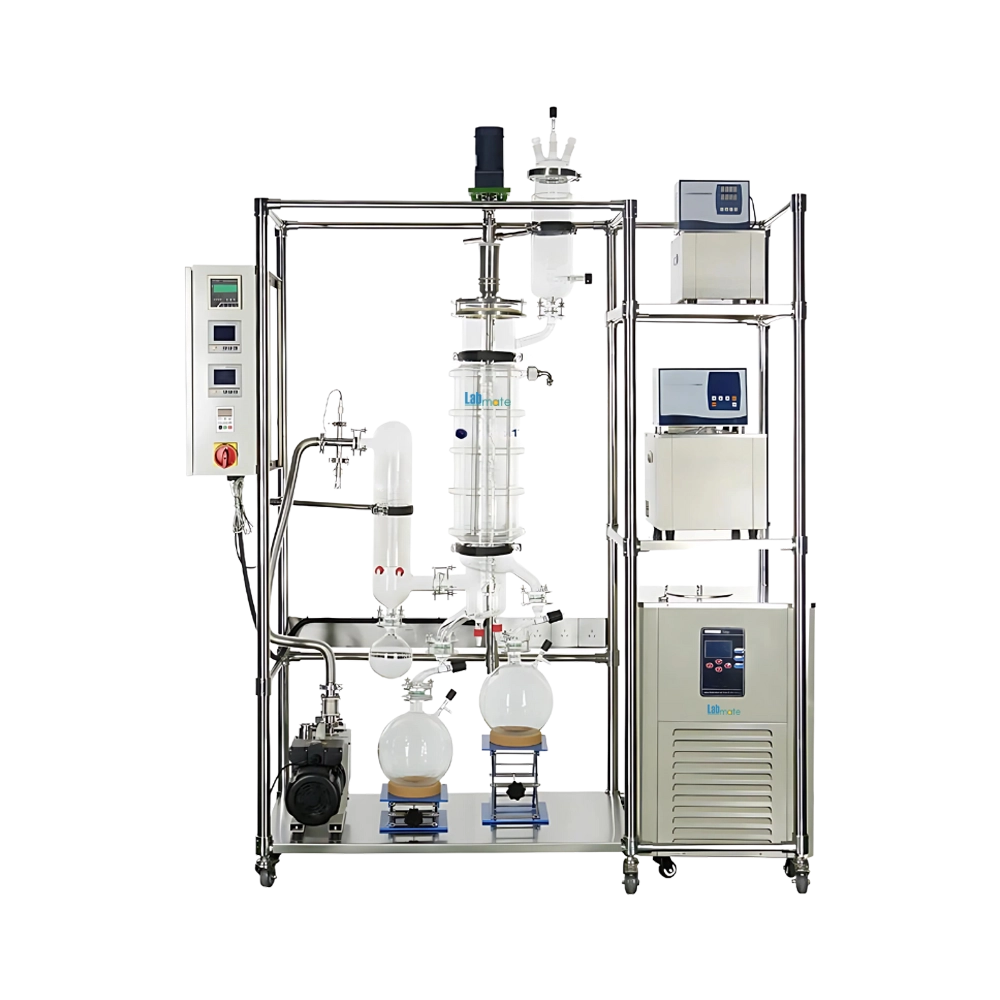
Molecular Distillation Unit LMMDU-A103 offers feeding rate of 0.2 to 10 L/h. It features digital Pirani gauge for real-time high-vacuum reading and monitoring. Equipped with scraper film, it enhances material contact and stability. Incorporating fully jacketed and insulated evaporators ensures consistent fluidity. Our Distiller is ideal for purification of drugs, chemicals, and extracts in biotech, petrochemical, and food industries.
Features :
Clear visibility
Intuitive visual process
Adjustable parameters
Corrosion resistance
Magnetic coupling seal
Fluorine rubber sealing
Effortless cleaning
Specifications :
| Feeding Rate | 0.2 to 10 L/h |
| Operating Temperature | Less than 300°C |
| Feeding Flask Volume | 2L |
| Distillate Receiving Flask Volume | 5L |
| Residue Receiving Flask Volume | 5L |
| Rotation Speed Range | 50 to 460 rpm |
| Vacuum Level | Less than or equal to 0.001millibar |
| Material | Borosilicate 3.3 |
| Evaporation Area | 0.25 m² |
| Power Supply | 220V/50Hz,1P |
| Dimensions | 1740×580×2320 mm |
Applications :
Molecular Distillation Unit LMMDU-A103 is widely applied in separation and purification of high-purity chemicals, drugs, extracts, and advanced materials in chemical, pharmaceutical, food, biotech, petrochemical, and material industries.
Selection Guide :
Molecular Distillation Unit LMMDU-A103 is designed for high-throughput applications requiring precision separation of thermally sensitive or high-boiling-point compounds. With a feeding rate of 0.2 to 10 L/h, this model is suitable for research studies and pilot-scale production in pharmaceuticals, fine chemicals, nutraceuticals, and cannabinoid refinement. Its 2L feeding flask and 5L distillate receiving flask support continuous operation and high-yield recovery, making it suitable for processing large volumes in compound purification, essential oil distillation, and vitamin concentration. Operating at temperatures below 300°C, it ensures the thermal stability of sensitive compounds. The unit is typically manufactured to comply with GMP and CE standards, supporting regulatory requirements in laboratory and industrial settings. This model is best suited for users seeking efficient separation at higher capacity while maintaining product integrity under vacuum conditions.