Get Quote
Contact us now to receive a detailed quotation.
Overview
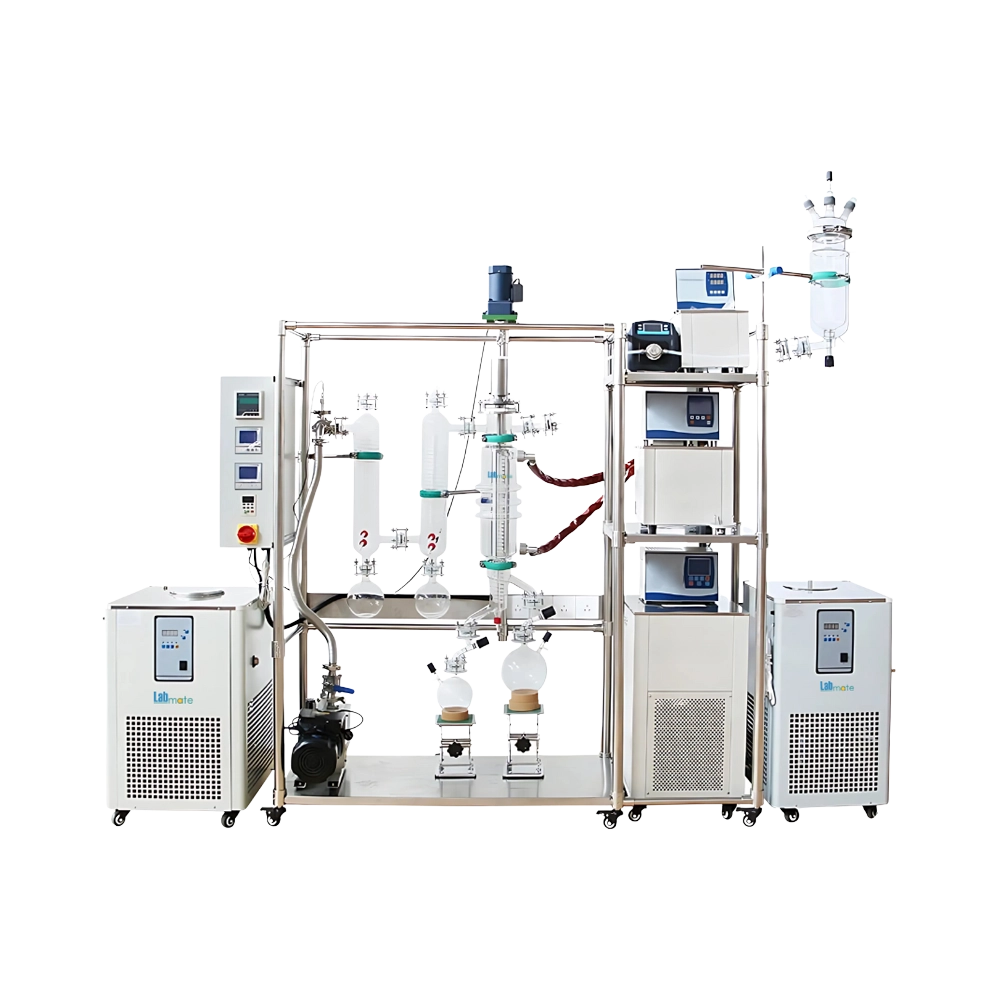
Molecular Distillation Unit LMMDU-A101 is designed with feeding rate of 0.05 to 3 L/h. Its durable scraper film enhances material contact and stability. Equipped with fluorine rubber or tetrafluoroethylene for reliable sealing by preventing leaks. Incorporates fully jacketed and insulated evaporator to ensures consistent fluidity. Our Distiller enables separation and purification of drugs and extracts in biotech, petrochemical industries etc.
Features :
High vacuum maintenance
Intuitive visual process
Adjustable parameters
Corrosion resistance
Magnetic coupling seal
Digital Pirani gauge
Specifications :
| Feeding Rate | 0.05 to 3 L/h |
| Operating Temperature | Less than 300°C |
| Feeding Flask Volume | 1L |
| Distillate Receiving Flask Volume | 1L |
| Residue Receiving Flask Volume | 1L |
| Rotation Speed Range | 50 to 460 rpm |
| Vacuum Level | Less than or equal to 0.001millibar |
| Material | Borosilicate 3.3 |
| Evaporation Area | 0.1 m² |
| Power Supply | 220V/50Hz,1P |
| Dimensions | 1540×580×1880mm |
Applications :
Molecular Distillation Unit LMMDU-A101 is ideal for separation and purification in chemical, pharmaceutical, food, biotech, petrochemical, and material industries, handling high-purity chemicals, drugs, extracts, and advanced materials.
Selection Guide :
Molecular Distillation Unit LMMDU-A101 is designed for the gentle separation of thermally sensitive and high-boiling-point substances under high vacuum. With a feeding rate of 0.05 to 3 L/h and operating temperature below 300°C, this model is best suited for medium-scale research or pilot plant operations. It is widely used in pharmaceutical, food, cosmetic, and cannabinoid industries for applications such as refining essential oils, vitamins, omega-3s, and bioactive compounds. The 1L feeding and distillate receiving flasks make it suitable for continuous or batch processing. Often selected for R&D and academic research, this model typically complies with GMP and CE certifications, helping customers meet industry regulatory standards. It is especially beneficial for experiments requiring high-purity separation with minimal thermal degradation.