
Get Quote
Contact us now to receive a detailed quotation.
Liquid Scintillation Counters measure beta-emitting isotopes by dissolving the sample in a scintillation cocktail, which converts each beta particle into a flash of light that photomultiplier tubes count. Counting efficiency reaches 50 to over 65% for tritium and 90 to 95% for carbon-14, the two main isotopes in tracer work. Quench correction by 3/2 and four-parameter fitting adjusts for colour and chemical quenching, converting counts to DPM, and an automatic changer runs 25 vials unattended. High-end models add alpha and beta discrimination across 3 to 10 MeV alpha and 0 to 5 MeV beta. Typical uses include tritium in drinking water, radiolabelled drug studies and receptor binding assays.
 Liquid Scintillation Counter LMSCL-A100 Catalog
| Detection Efficiency (³H) | Greater than or equal to 50% |
| Background Count Rate (³H) | Less than or equal to 40 cpm |
| Detection Efficiency (¹⁴C) | Greater than or equal to 90% |
| Background Count Rate (¹⁴C) | Less than or equal to 60 cpm |
| Working Modes | Counting, Quench Correction, DPM Measurement |
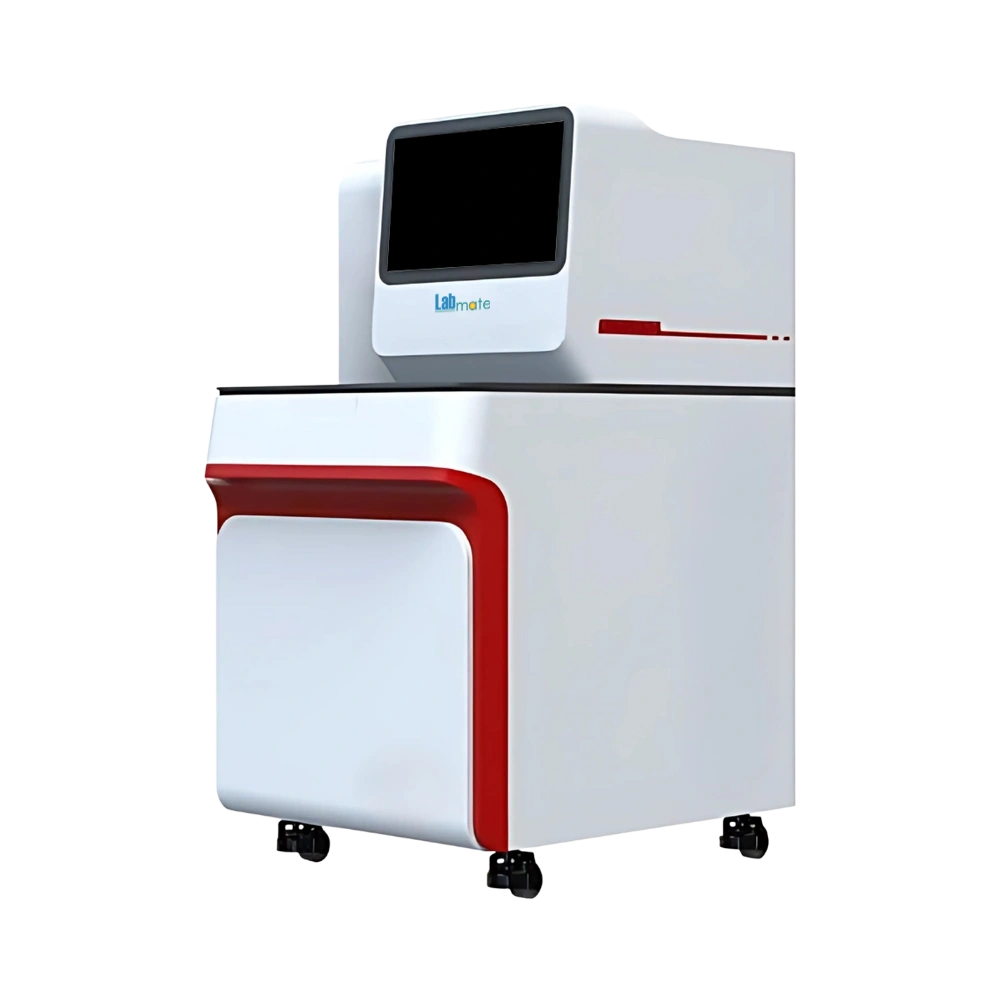 Liquid Scintillation Counter LMSCL-A101 Catalog
| Detection Range | α: 3 to 10MeV, β: 0 to 5MeV |
| Detection Efficiency (³H) | Greater than 65% |
| Detection Efficiency (¹⁴C) | Greater than or equal to 95% |
| Background Count Rate (³H) | Greater than 1.0cpm |
| Background Count Rate (¹⁴C) | Less than or equal to 1.0cpm |